
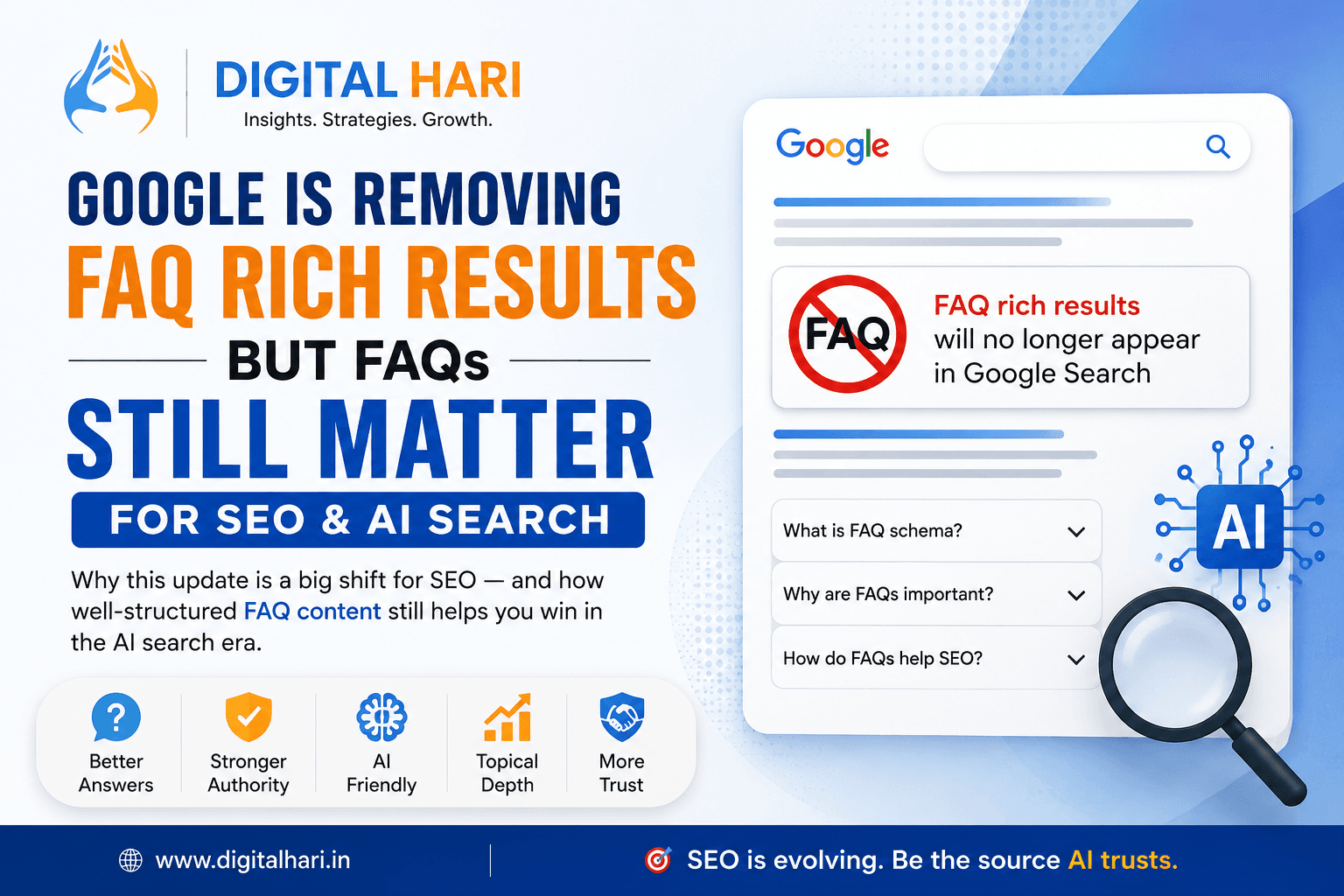
For years, FAQ schema was one of the most commonly recommended SEO tactics in the digital marketing industry.
Almost every SEO plugin encouraged website owners to use it.
Many optimization checklists included it.
And countless websites added FAQ sections hoping to gain more visibility in Google Search.
At one point, FAQ rich results became a powerful way to:
- Occupy more SERP space
- Improve click-through rates
- Push competitors lower in search results
- Increase visibility without improving actual rankings
For many businesses, it became a standard SEO practice.
But now, Google has officially confirmed a major change.
FAQ rich results are being removed from Search.
Google is also phasing out:
- FAQ reports in Search Console
- FAQ support in Rich Results Test
- API support related to FAQ rich results
For many people in SEO, this feels like the end of a long-standing strategy.
But according to Hariharan Gandhi, founder of Digital Hari, this update reflects a much bigger transformation happening inside modern search.
And honestly, many businesses are still misunderstanding what this change truly means.
The Real Problem With FAQ Schema Over the Years
Over time, FAQ schema slowly stopped being about helping users.
Instead, many websites started treating FAQ sections like a shortcut for visibility.
Businesses began publishing FAQs that:
- Nobody genuinely asked
- Repeated keywords unnaturally
- Added little or no value
- Existed only to manipulate SERP appearance
Examples like these became extremely common:
“Best SEO Freelancer in Texas?”
“Yes, we are the best SEO freelancer in Texas.”
Or:
“Who provides the best plumbing services in Dallas?”
“We provide the best plumbing services in Dallas.”
These were not real user-focused FAQs.
They were created mainly to gain extra search visibility.
According to Hariharan Gandhi, this trend gradually reduced the overall quality of FAQ rich results across Google Search.
Instead of improving user experience, many websites started overusing FAQ schema purely for ranking advantages.
And eventually, Google responded.
What Google Is Actually Removing
This is where many beginners are getting confused.
Google is removing:
- FAQ rich snippets in Search results
- FAQ-related Search Console reports
- FAQ testing support in Rich Results tools
But Google is not saying FAQ content itself is useless.
That distinction matters a lot.
Because many website owners are now wondering:
“Should FAQ sections be removed completely?”
The answer is no.
In fact, according to Digital Hari, well-structured FAQ content may become even more valuable moving forward — especially in AI-driven search environments.
Why FAQs Still Matter in 2026
Traditional SEO focused heavily on:
- Rankings
- CTR optimization
- SERP enhancements
- Keyword positions
- Rich snippet visibility
But search itself is evolving rapidly.
Now the industry is moving toward:
- AI-generated summaries
- Conversational search
- Context-based understanding
- Semantic relevance
- Intent-driven experiences
Platforms like:
- ChatGPT
- Gemini
- Perplexity
Do not process information the same way traditional search engines did years ago.
Instead, these systems analyze:
- Content clarity
- Structure
- Context
- Topic relationships
- User intent
And this is exactly where FAQ sections still provide strong value.
According to Hariharan Gandhi, the future of SEO is no longer just about ranking pages.
It is increasingly about becoming understandable to AI systems.
The Future of SEO Is Becoming AI-Friendly
Many businesses still think SEO means:
“Add keywords and rank.”
But modern SEO has become much more advanced.
AI systems now evaluate:
- Whether content genuinely answers questions
- Whether explanations are clear
- Whether information feels trustworthy
- Whether topics are covered deeply
- Whether content demonstrates real expertise
This changes SEO strategy completely.
Now the goal is not only:
“How can rankings improve?”
The bigger question becomes:
“How can content become understandable, trustworthy, and useful for both users and AI systems?”
That is a massive shift.
And FAQ sections support exactly that when written properly.
Why FAQ Content Helps AI Systems
This is one of the most important concepts beginners should understand.
AI systems prefer structured clarity.
A strong FAQ section naturally provides:
- Questions
- Direct answers
- Contextual depth
- Topic expansion
- Semantic relationships
This makes it easier for AI systems to understand content.
For example:
If a blog discusses local SEO and includes FAQs such as:
- How long does local SEO take?
- Does Google Business Profile affect rankings?
- Is local SEO still worth it in 2026?
AI systems gain a clearer understanding of the overall topic.
According to Digital Hari, this strengthens topical authority naturally without relying on keyword stuffing.
Topical Authority Matters More Than Ever
One of the biggest changes happening in SEO today is the growing importance of topical authority.
According to Hariharan Gandhi, future SEO winners will not simply be websites with the highest keyword density.
Instead, the strongest websites will be the ones that:
- Explain topics clearly
- Cover subjects deeply
- Answer related questions naturally
- Build trust consistently
- Demonstrate genuine expertise
This is exactly why FAQ sections still matter.
Not because of SERP tricks.
But because they improve understanding.
And understanding is becoming one of the biggest factors in both AI search visibility and modern SEO performance.
The Shift From Search Engines to Answer Engines
Another major transformation happening right now is this:
Search engines are slowly becoming answer engines.
Traditional search mainly helped users discover websites.
But AI-driven systems increasingly provide:
- Direct summaries
- Contextual answers
- Recommendations
- Conversational responses
That means content must become easier to interpret, summarize, and understand.
And well-written FAQ sections support this naturally.
According to Hariharan Gandhi, businesses focusing only on traditional SEO tricks may struggle in the future because AI-driven search systems prioritize clarity and understanding over manipulative optimization tactics.
Why Businesses Should Stop Treating FAQs Like SEO Tricks
One of the biggest mistakes businesses still make is writing FAQs purely for algorithms.
Not for users.
Examples include:
- Keyword-stuffed questions
- Fake user queries
- Robotic answers
- Repetitive keyword targeting
Modern SEO is moving away from this approach completely.
Now content needs to feel:
- Natural
- Helpful
- Human
- Clear
- Experience-driven
Especially in AI-driven search environments.
And honestly, this is a healthy shift for the SEO industry overall.
The Perspective From Digital Hari
According to Hariharan Gandhi, Google removing FAQ rich results is not the death of FAQ content.
It is simply the end of one visual SERP feature.
The deeper value of FAQs is actually becoming more important because AI systems depend heavily on:
- Structured explanations
- Contextual understanding
- Clear answers
- Topical relationships
At Digital Hari, the focus is increasingly moving toward creating content that is:
- User-friendly
- AI-readable
- Semantically strong
- Experience-driven
- Built around trust instead of shortcuts
Because algorithms constantly evolve.
But genuinely useful content continues to survive every update.
Search Is Becoming More Conversational
Traditional search behavior was heavily keyword-driven.
People used to search like this:
- “best seo agency”
- “local seo services”
- “faq schema seo”
But modern search behavior is becoming much more natural and conversational.
Now users search like this:
- “Why did Google remove FAQ rich results?”
- “Do FAQ sections still help SEO?”
- “Will AI search replace traditional rankings?”
- “How can websites optimize for AI search?”
This change is extremely important.
Because AI systems process language differently than traditional search engines.
They focus more on:
- Meaning
- Context
- Relationships between topics
- User intent
- Conversational understanding
This is one reason why FAQ content still matters so much.
Well-structured FAQs naturally match conversational search behavior.
Why AI Systems Prefer Structured Content
AI search systems are designed to extract and summarize information quickly.
That means they prefer content that is:
- Easy to interpret
- Clearly organized
- Context-rich
- Structured logically
- Written naturally
This is where many websites struggle.
Some websites still create content purely for algorithms instead of for actual understanding.
According to Hariharan Gandhi, this old SEO mindset is becoming increasingly risky.
Because AI-driven search environments prioritize clarity much more than keyword repetition.
Beginner Mistakes Businesses Should Avoid
Many beginners are now reacting emotionally to Google’s FAQ update.
And that’s creating new mistakes.
Here are some of the most common ones.
Mistake 1 — Removing All FAQ Sections
Some businesses immediately started deleting FAQ sections from their websites.
That is the wrong approach.
FAQs still provide huge value for:
- User experience
- Topic clarification
- AI understanding
- Conversational search alignment
The smarter approach is improving FAQ quality — not removing them completely.
Mistake 2 — Stuffing Questions With Keywords
This was already a problem before the update.
Many websites created FAQs like:
“Best SEO agency in Florida?”
“Affordable HVAC company in Texas?”
“Top plumber in Dallas?”
These questions often sounded unnatural because they existed only for rankings.
According to Digital Hari, modern SEO is moving away from this kind of manipulation.
AI systems increasingly evaluate whether content feels genuinely helpful.
Mistake 3 — Writing Robotic Answers
Another major issue is robotic content.
Some FAQ answers sound like they were written only for search engines.
For example:
“SEO is important because SEO improves SEO visibility for SEO websites.”
That type of writing feels unnatural immediately.
Modern SEO content must feel:
- Human
- Beginner-friendly
- Helpful
- Experience-driven
Especially because AI systems are becoming better at understanding language quality.
Why Beginner-Friendly Content Matters More Than Ever
One major trend happening in modern SEO is the growing importance of readability.
According to Hariharan Gandhi, businesses often make content too technical unnecessarily.
But AI-driven search environments increasingly reward content that explains concepts clearly.
This is especially important for beginners.
For example:
Instead of saying:
“Semantic entity relationships improve contextual relevance.”
A beginner-friendly explanation would be:
“Google and AI systems now try to understand how topics connect with each other.”
The second version feels clearer and easier to understand.
And clarity is becoming one of the biggest SEO advantages moving forward.
The Future of SEO Is About Trust
For years, many SEO strategies focused on manipulating visibility.
But modern search systems increasingly focus on trust.
That means AI systems evaluate whether content:
- Feels reliable
- Demonstrates expertise
- Explains topics clearly
- Covers topics deeply
- Provides useful answers
According to Digital Hari, trust signals are becoming one of the most important factors in modern SEO.
And trust is not built through tricks.
It is built through:
- Clear explanations
- Consistent quality
- Real expertise
- Helpful content
- Strong topical understanding
Why Topical Depth Matters in AI Search
One thing many businesses still misunderstand is this:
AI systems do not only evaluate individual keywords.
They evaluate overall topical understanding.
For example:
If a website discusses:
- SEO
- AI search
- FAQ schema
- conversational search
- topical authority
- content clarity
Together naturally, AI systems understand the broader topic more effectively.
This strengthens authority.
According to Hariharan Gandhi, this is why future SEO strategies must focus more on topic ecosystems instead of isolated keywords.
The Rise of AI Search Visibility
Traditional SEO focused heavily on ranking positions.
But visibility itself is evolving rapidly.
Now content can appear through:
- AI summaries
- Conversational recommendations
- Search assistants
- AI-generated answers
This means businesses must optimize not only for rankings…
But also for understanding.
And structured FAQ sections still help support that process.
Because they provide:
- Direct answers
- Clear context
- Topic relationships
- Conversational phrasing
All of these help AI systems process information more effectively.
What Businesses Should Focus On Now
According to Digital Hari, businesses should stop obsessing over short-term SEO tricks.
Instead, focus should shift toward:
- Better content quality
- Clear explanations
- Conversational writing
- Topical authority
- User understanding
- AI-friendly structure
This is where modern SEO is heading.
Not toward manipulation.
But toward usefulness.
How to Write Better FAQs in 2026
Businesses should now approach FAQs differently.
Good FAQ sections should:
- Answer real user questions
- Expand topic understanding
- Clarify confusion naturally
- Improve readability
- Support conversational search
And most importantly:
FAQs should feel genuinely helpful.
Not artificially optimized.
According to Hariharan Gandhi, this shift toward natural clarity is one of the most important content changes businesses should understand moving forward.
Why This Update Is Actually Healthy for SEO
At first glance, many people see Google removing FAQ rich results as negative.
But in reality, it may improve content quality long term.
Because it reduces incentive for:
- Keyword-stuffed FAQs
- Fake question targeting
- Low-value SERP manipulation
- Repetitive schema abuse
And instead encourages websites to focus on:
- Real expertise
- Helpful explanations
- Better structure
- Stronger topical clarity
That is a healthier direction for the SEO industry overall.
Final Thoughts From Hariharan Gandhi & Digital Hari
According to Hariharan Gandhi, the future of SEO is no longer just about chasing rankings.
It is increasingly about becoming understandable, trustworthy, and useful in AI-driven search environments.
Google removing FAQ rich results does not mean FAQ content is dead.
It simply means one visual feature is disappearing.
But the deeper value of FAQs is actually growing stronger because AI systems rely heavily on:
- Clear structure
- Contextual understanding
- Conversational relevance
- Direct explanations
At Digital Hari, the focus is increasingly centered around creating content that works for:
- Real users
- AI systems
- Conversational search
- Long-term topical authority
Because algorithms will continue changing.
But genuinely useful content will always remain valuable.
Frequently Asked Questions About Google Removing FAQ Rich Results
What are FAQ rich results in Google Search?
FAQ rich results are expandable question-and-answer sections that previously appeared directly in Google Search results. They were created using FAQ schema markup to improve visibility and provide quick answers to users.
Has Google officially removed FAQ rich results?
Yes. Google has officially announced that FAQ rich results are being phased out from Search. Google is also removing FAQ reports from Search Console and deprecating related API support.
Does this mean FAQ content is no longer useful for SEO?
No. FAQ content is still highly valuable for SEO and AI search understanding. Well-structured FAQs help improve topical authority, support conversational search, and make content easier for AI systems to understand.
Why is Google removing FAQ rich snippets?
Google likely reduced FAQ rich results because many websites started overusing FAQ schema for SEO manipulation instead of improving user experience. Low-quality and keyword-stuffed FAQs became extremely common.
Should websites remove FAQ sections now?
No. Businesses should not remove FAQ sections completely. Instead, they should focus on writing useful, beginner-friendly, and genuinely helpful FAQs that improve content understanding.
How do FAQs help AI search platforms like ChatGPT and Gemini?
FAQ sections provide structured questions and direct answers, which help AI systems better understand topics, extract relevant information, and generate clearer summaries.
Are FAQs still important for AI-friendly SEO?
Yes. According to Hariharan Gandhi from Digital Hari, FAQs remain valuable because AI-driven search environments prioritize clarity, conversational structure, and contextual understanding.
What type of FAQs work best in 2026?
The best FAQs are: Beginner-friendly Natural sounding Helpful Conversational Based on real user questions Keyword-stuffed or robotic FAQs are becoming less effective.
What is the future of SEO after FAQ rich results?
The future of SEO is moving toward: AI search visibility Topical authority Conversational content Structured clarity Trust-based optimization According to Digital Hari, becoming a trusted source for AI-generated answers will become more important than chasing traditional SERP features.
Do FAQ sections still help with topical authority?
Yes. FAQ sections help expand topic coverage naturally and improve semantic understanding, which strengthens topical authority for both search engines and AI systems.