
For years, Google Search Console has been one of the most important free tools for SEO professionals, website owners, bloggers, and digital marketers.
It has helped us understand how websites perform in Google Search by providing valuable insights into impressions, clicks, search queries, indexing, Core Web Vitals, and technical SEO.
However, there has always been one major limitation.
If someone discovered your Instagram Reel, YouTube video, TikTok post, or X (formerly Twitter) post through Google Search, there was no dedicated way to understand that performance inside Search Console.
That has finally changed.
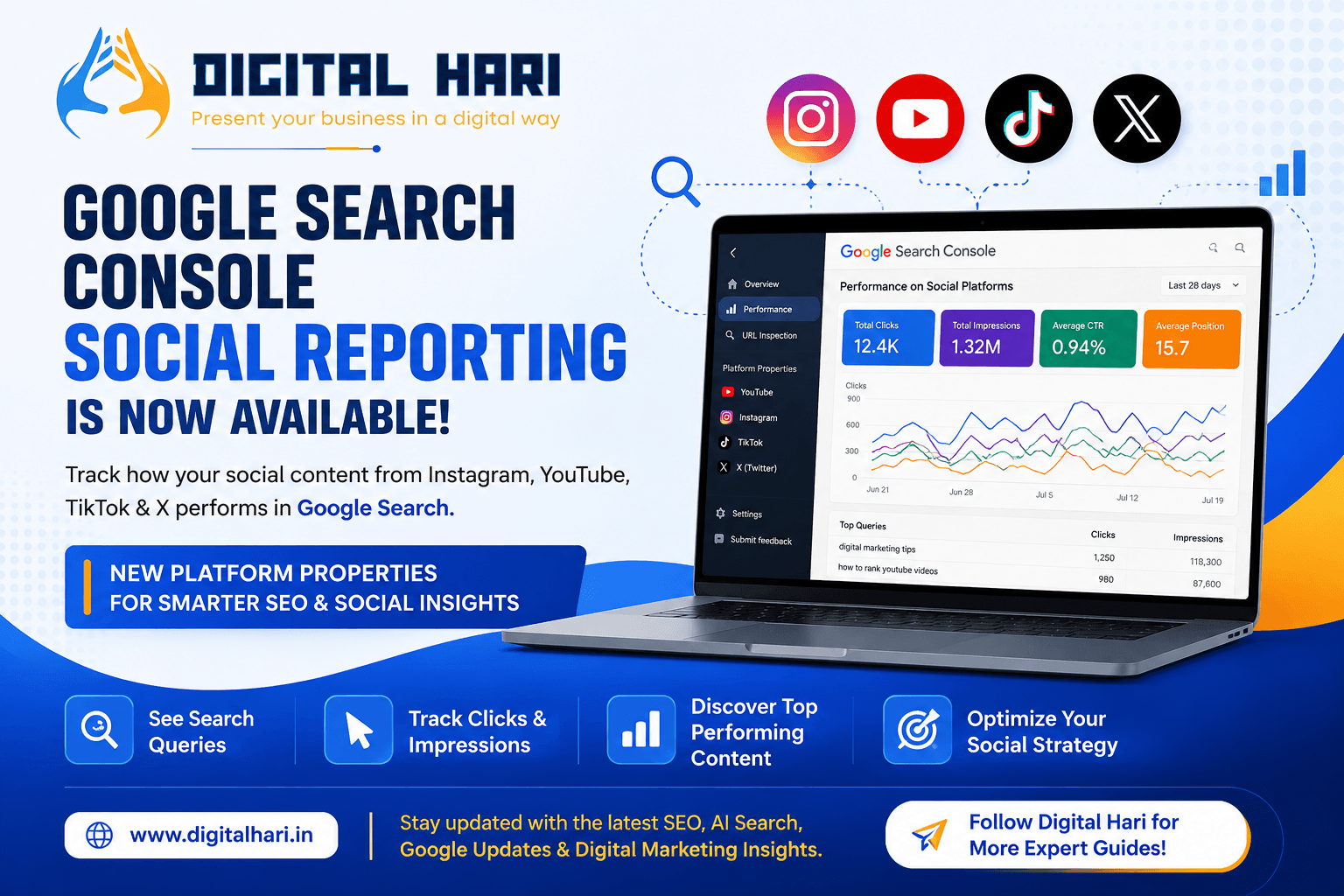
Google has officially expanded Search Console Platform Properties, allowing eligible creators and businesses to track how their public social content performs in Google Search. This marks one of the most significant Search Console updates in recent years because it recognizes that search is no longer limited to traditional websites.
For many people, this may look like “just another Search Console feature.”
I believe it represents something much bigger.
It reflects Google’s vision of search becoming an ecosystem where websites, videos, social posts, creator profiles, and AI-generated answers all contribute to a brand’s online visibility.
Let’s explore what this update means and why every business should pay attention.
Search Has Changed Dramatically
Ten years ago, ranking a website on Google was the primary goal of SEO.
Today, users discover businesses through many different channels.
A customer might:
- Search Google
- Watch a YouTube Short
- Discover an Instagram Reel
- Read an X post
- Find a TikTok tutorial
- Ask ChatGPT
- Use Google AI Search
These touchpoints are increasingly connected.
Google understands that users consume information in multiple formats, which is why Search Console is evolving beyond websites.
What Google Announced
Google has introduced Platform Properties in Search Console.
Instead of tracking only domains like:
https://example.comSearch Console can now track supported public creator and social profiles as separate properties.
Eligible users can verify supported platform accounts and access search performance data similar to what website owners receive for traditional web properties.
This is a major step toward unifying website SEO and social search visibility.
Supported Platforms
At launch, Google supports several major content platforms, including:
- YouTube
- TikTok
- X (formerly Twitter)
Google may expand support to additional platforms in the future as the ecosystem evolves.
What Data Can You See?
Platform Properties provide insights into how users discover your social content through Google Search.
Depending on the platform and available reporting, creators can access metrics such as:
- Search impressions
- Clicks
- Search queries
- Click-through rate (CTR)
- Performance trends
- Top-performing content
This means marketers can better understand which search queries lead users from Google Search to their social content.
Website Properties vs Platform Properties
| Website Property | Platform Property |
|---|---|
| Tracks websites | Tracks supported social profiles |
| Focuses on webpages | Focuses on public social content |
| Technical SEO reports | Search performance reports |
| Indexing reports | Platform search insights |
| Sitemap support | Platform-specific verification |
| Page Experience | Search visibility for platform content |
Rather than replacing website properties, Platform Properties complement them by giving a more complete picture of your online presence.
Why This Update Matters More Than Most People Realize
Many articles describe this as a reporting enhancement.
I see it differently.
Google is acknowledging that valuable content lives beyond websites.
A well-crafted YouTube tutorial or Instagram Reel can answer a user’s question just as effectively as a traditional blog post.
By measuring social content in Search Console, Google is reinforcing that these assets are part of the broader search ecosystem.
The Rise of Social SEO
For years, SEO and social media marketing were treated as separate disciplines.
SEO focused on search engines.
Social media focused on engagement.
Today, those boundaries are disappearing.
A searchable YouTube video can generate organic traffic.
An Instagram Reel can appear in Google Search.
A TikTok tutorial can answer informational queries.
This means social content deserves the same strategic planning that marketers already apply to websites.
What Is Social SEO?
Social SEO is the practice of optimizing social media content so it can be discovered through search engines and platform search features.
It includes:
- Descriptive captions
- Natural language keywords
- Relevant hashtags
- Clear titles
- Consistent branding
- Helpful educational content
- High-quality visuals
The goal is not simply to gain likes.
The goal is to become discoverable.
Google Is Becoming an Entity Search Engine
One of the biggest shifts in modern SEO is Google’s increasing focus on entities rather than isolated keywords.
An entity can be:
- A business
- A person
- A product
- A location
- An organization
Instead of evaluating only webpages, Google increasingly understands relationships between these entities across multiple platforms.
For example, your website, YouTube channel, Instagram profile, and Google Business Profile may all contribute to Google’s understanding of your brand.
Platform Properties fit naturally into this broader trend.
The Connection to AI Search
This update also aligns with Google’s ongoing investment in AI-powered search experiences.
AI systems rely on trustworthy, well-structured, and authoritative information.
Public social content often contains:
- Demonstrations
- Tutorials
- Product reviews
- Customer experiences
- Educational explanations
These content types help AI systems understand expertise and context.
While Google has not stated that Platform Properties directly influence AI-generated answers, the update reflects a broader movement toward recognizing multiple content formats within search.
What This Means for Businesses
If your business only publishes occasional promotional posts, you’re missing an opportunity.
Instead, consider creating social content that answers real customer questions.
Examples include:
- Frequently asked questions
- Product demonstrations
- Industry tips
- Behind-the-scenes videos
- Customer success stories
- Educational explainers
- Local community updates
This type of content is valuable for both users and search visibility.
Local Businesses Can Benefit Too
Imagine a restaurant publishing short recipe videos.
Or a dentist sharing oral health tips.
Or a plumber demonstrating common repair techniques.
If these posts become discoverable through Google Search, they can attract new audiences who may never have visited the business’s website first.
That’s why local businesses should think beyond traditional website SEO.
How Agencies Should Adapt
Digital marketing agencies should begin integrating Platform Properties into their reporting workflows.
Instead of reporting only:
- Keyword rankings
- Organic traffic
- Backlinks
They can also evaluate:
- Search visibility for social content
- Queries leading to videos
- Search performance of creator profiles
- Cross-platform discoverability
This creates a more complete understanding of a client’s online presence.
Common Mistakes to Avoid
Many businesses may misunderstand this feature.
Here are a few common mistakes:
Mistake 1: Treating It Like Social Analytics
Platform Properties are not a replacement for Instagram Insights, YouTube Analytics, or TikTok Analytics.
They specifically measure how users discover your content through Google Search.
Mistake 2: Ignoring Search Intent
Publishing content without considering what users are searching for reduces discoverability.
Create content that answers real questions.
Mistake 3: Using Generic Captions
Captions should clearly describe the content instead of relying solely on emojis or vague phrases.
Mistake 4: Separating SEO and Social Teams
SEO specialists and social media managers should collaborate more closely than ever before.
My Perspective
In my view, this announcement is not simply about adding more reports to Search Console.
It reflects a broader shift in how Google views online content.
Search is becoming platform-independent.
Users no longer care whether information comes from a webpage, a video, or a social post.
They simply want the best answer.
Businesses that consistently publish useful, trustworthy, and well-structured content across multiple platforms are likely to be better positioned for the future of search.
This doesn’t mean websites are becoming less important.
On the contrary, websites remain the foundation of a strong digital presence.
But websites should now work alongside social content rather than existing in isolation.
The Future of SEO Is Multi-Platform
Traditional SEO focused primarily on webpages.
Modern SEO increasingly includes:
- Websites
- Videos
- Creator profiles
- Social posts
- AI-readable content
- Entity optimization
- User experience
Search is becoming more connected than ever before.
Businesses that embrace this shift today will be better prepared for tomorrow’s search landscape.
Final Thoughts
Google Search Console’s new Platform Properties represent more than just an additional reporting feature—they signal a broader evolution in how Google understands and measures content across the web.
For years, SEO strategies focused almost entirely on websites. Today, valuable content exists across multiple platforms, including YouTube, Instagram, TikTok, and X. By bringing social content performance into Search Console, Google is acknowledging that search visibility is no longer limited to webpages alone.
This update also reinforces an important shift in digital marketing: creating helpful, trustworthy, and searchable content wherever your audience spends time. Businesses that integrate website SEO with social content strategies will be better positioned as search continues to evolve alongside AI-powered experiences.
While Platform Properties are still relatively new, they provide marketers, creators, and businesses with another valuable source of search insights. Understanding how people discover your content across different platforms can help you make smarter decisions, refine your content strategy, and strengthen your overall online presence.
The future of search is becoming increasingly interconnected, and staying informed about these changes will help you adapt more effectively as Google’s ecosystem continues to evolve.
Frequently Asked Questions
1. What are Google Search Console Platform Properties?
Platform Properties allow eligible creators and businesses to monitor how their supported social profiles perform in Google Search.
2. Which platforms are currently supported?
Google currently supports major platforms including YouTube, Instagram, TikTok, and X, with potential expansion over time.
3. Does this replace website properties?
No. Platform Properties complement traditional website properties and provide additional visibility into social content performance.
4. Does this affect AI Search?
Google has not said Platform Properties directly influence AI Overviews or other AI experiences. However, the update reflects Google's broader recognition of multiple content formats within search.
5. Should small businesses care about this update?
Yes. Even small businesses can benefit by creating helpful, searchable social content that complements their website and local SEO strategy.
Stay Updated with the Latest SEO & AI Search Trends
Google Search is evolving faster than ever, with AI-powered search experiences, new Search Console features, and continuous algorithm updates reshaping how businesses achieve online visibility. Keeping up with these changes is no longer optional—it’s essential for staying competitive.
At Digital Hari, we regularly publish in-depth guides, industry news, practical tutorials, and expert insights covering SEO, AI Search, Google Search Console, Technical SEO, Local SEO, WordPress SEO, and the latest digital marketing trends.
Whether you’re a business owner, digital marketer, SEO professional, or content creator, our goal is to help you understand complex search updates and turn them into actionable strategies.
👉 Explore more expert guides:
https://digitalhari.in/blog/
💬 Have questions or thoughts about this Google Search Console update? Share your opinion in the comments below and join the discussion. If you found this guide useful, don’t forget to share it with your team and network.
About the Author
Hariharan Gandhi is the Founder of Digital Hari, a digital marketing consultant specializing in SEO, AI Search Optimization, Technical SEO, Local SEO, WordPress SEO, and Google Business Profile optimization. With years of experience helping businesses improve their online presence, he regularly publishes research-backed articles, tutorials, and practical SEO strategies to help marketers stay ahead of Google’s evolving search landscape.
Follow Digital Hari for the latest insights on SEO, AI Search, Google Search Console, WordPress, AI-powered search, and digital marketing.
[…] Google Search Console social media reporting […]