
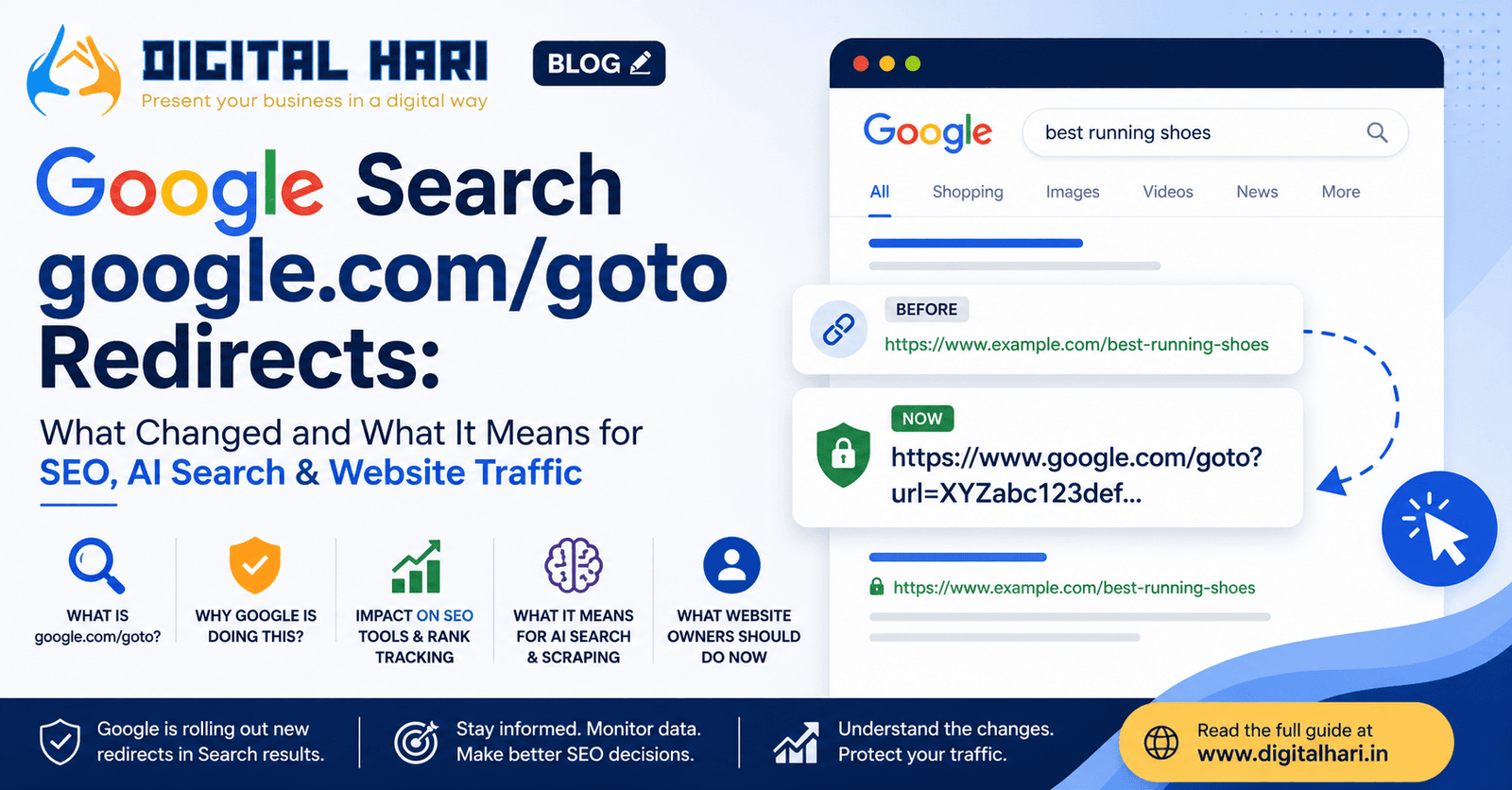
Google Search is changing another important part of how search results work.
If you have recently hovered over a Google Search result and noticed a strange URL beginning with google.com/goto instead of seeing the destination website URL directly, you are not imagining it.
Google has been testing and rolling out a new passthrough URL system in which some Search result clicks are routed through a Google-owned google.com/goto URL before the user reaches the actual website.
The change was reported during testing in July 2026 and became much more visible in August. On August 26, 2026, Google confirmed that the rollout is happening, describing it as part of its efforts to deploy “technical measures against evolving forms of abuse.”
At first glance, this may look like a small technical change.
It isn’t.
For normal searchers, the immediate experience may be almost identical: click a result and reach the same website.
But for SEO tools, rank trackers, SERP APIs, search-data providers, scraping systems, and potentially some AI-related search workflows, the change could be much more significant.
This article explains what is happening in simple language, what is confirmed, what is still speculation, and what website owners and SEO professionals should do next.
What Is Google google.com/goto?
In simple terms, Google is putting an intermediate Google URL between some Search results and the destination website.
Previously, a search result could point directly to the destination:
Google Search → Website
With the reported google.com/goto behavior, the path can look more like:
Google Search → google.com/goto → Website
The goto URL contains an encoded or hashed representation of the destination rather than simply exposing the destination URL in the same way.
Search Engine Land describes this as a redirect hop through google.com/goto?url=[hashURL], after which Google sends the visitor to the original destination.
The important point is that this is primarily a click-path and data-access change.
It is not evidence that Google has changed how your website ranks.
What Exactly Changed?
Let’s make the difference easy to understand.
Before
A Google Search result could expose the destination link directly.
A search-data system could potentially inspect the result and identify:
- The destination domain
- The destination URL
- The position of the result
- The page associated with the result
Now
Some Search result links can point to something similar to:
google.com/goto?url=[encoded-value]
Google processes that request and then sends the visitor to the destination page.
The destination has not necessarily changed.
The route has changed.
Search Engine Land reported that Google confirmed the rollout and explained it as a technical measure intended to protect its services and users from evolving forms of abuse.
When Did Google Start Testing google.com/goto?
The change did not suddenly appear on August 26.
Search Engine Roundtable reported that Google had been testing the google.com/goto passthrough behavior since July 2026.
The report also included observations from Derek Perkins of Nozzle, who said the change had reached nearly 100% rollout across several residential IP providers that he tested.
That figure should be understood correctly.
It does not mean that every Google user, browser, country, query, device, or Search surface was necessarily seeing the same behavior.
It describes the environments that were tested.
That distinction is important when discussing a rollout that may still vary by:
- Location
- IP
- Browser
- Search surface
- Device
- Query
- Account
- Testing bucket
Why Is Google Doing This?
This is where the discussion becomes interesting.
Google’s official explanation is deliberately broad.
A Google spokesperson told Search Engine Roundtable:
“We have a long history of deploying technical measures against evolving forms of abuse, and we regularly take steps to protect our services and users.”
That’s the confirmed Google position.
Google has not publicly published a detailed technical explanation saying exactly which companies, tools, or systems this change is targeting.
However, the industry reporting provides important context.
Is Google Trying to Stop Search Scraping?
That appears to be one of the major reasons the SEO industry is considering.
Search Engine Roundtable reported that the change appears designed to make it more difficult for third-party tools and AI companies to scrape Google Search results.
Why would a redirect help?
Because a search-data provider can no longer necessarily read a straightforward destination URL directly from the Search result.
Instead, it may have to:
- Retrieve the Google result.
- Identify the
google.com/gotoURL. - Process the encoded value.
- Follow the redirect.
- Determine the final destination.
- Continue collecting and processing the Search data.
That creates additional work.
Why Are Encoded goto Links Important?
According to the observations reported by Nozzle and published by Search Engine Roundtable, the goto links cannot simply be decoded in the normal way.
That means a provider may have to actually follow the redirect to determine where the result leads.
Imagine a Google Search page containing many results.
A human user can simply click.
A search-data provider may need to process many result destinations automatically.
If every result requires additional redirect handling, the infrastructure requirements can increase.
And if Google continues making automated access more difficult, the technical burden could become greater.
This is why the change matters much more to automated systems than to ordinary searchers.
Does This Mean Google Is Targeting OpenAI?
This is one of the biggest claims currently circulating.
There is a reason people are discussing AI companies in connection with this change.
AI systems increasingly need access to information from the web, and some search and grounding systems use search-result data or third-party search infrastructure.
Search Engine Roundtable specifically discussed AI companies alongside search scraping tools in its analysis.
But there is an important distinction:
There is no public Google statement confirming that the google.com/goto rollout was specifically created to increase costs for OpenAI.
So saying:
“Google created
google.com/gotospecifically to increase OpenAI’s grounding costs.”
would be stronger than the available evidence supports.
A more accurate statement is:
The rollout appears likely to make automated access to Google Search result destinations more difficult and potentially more expensive for third-party search-data systems, scrapers, and some AI-related infrastructure. Google’s public explanation is that the measures address evolving forms of abuse.
That is a much safer and more evidence-based conclusion.
Why Would This Matter to AI Search?
AI Search has changed the importance of search-result data.
Traditional search engines mainly return ranked links.
AI systems can use web information to:
- Find sources
- Retrieve information
- Compare pages
- Generate answers
- Identify entities
- Understand current events
- Provide citations
- Support research
This creates a growing ecosystem of:
- Search APIs
- SERP APIs
- Crawlers
- Retrieval systems
- Rank tracking platforms
- AI search visibility tools
- Grounding systems
A change to Google’s result-link infrastructure can therefore have consequences beyond traditional SEO tools.
However, we should not confuse Google Search result click routing with the internal operation of every AI search system.
The available reporting does not prove that Google goto redirects directly block ChatGPT, Claude, Perplexity, or every other AI system.
Different AI products have different retrieval architectures.
The impact will depend on what each system actually uses.
Google goto Is Not a Google Ranking Update
This is perhaps the most important point for website owners.
There is currently no evidence that google.com/goto itself changes:
- Your rankings
- Your indexing
- Your keyword relevance
- Your backlinks
- Your content quality
- Your Core Web Vitals
- Your structured data
- Your crawlability
The change happens after Google has already produced the Search result.
Think about the stages separately.
Ranking
Google decides where your page should appear.
Search result
Google displays your page as a result.
Click
The user selects the result.
Redirect
The user may pass through google.com/goto.
Destination
The user reaches your website.
The goto change concerns the click path.
It does not, by itself, demonstrate a change to the ranking system.
GoodFellas Tech also emphasizes this distinction, describing the rollout as an infrastructure and measurement issue rather than evidence of a ranking or indexing change.
Will My Website Lose Rankings Because of google.com/goto?
There is no evidence from the reviewed reports that the google.com/goto rollout itself causes websites to lose rankings.
So if a third-party rank tracker suddenly reports unusual results, don’t immediately assume:
“Google penalized my website.”
First ask:
Could the tool’s collection method have changed?
Search Engine Land specifically warned that third-party Google Search tracking tools may be affected and recommended watching their reporting.
This distinction is critical.
A tool can have a measurement problem without your website having a ranking problem.
Could Rank Tracking Tools Be Affected?
Yes.
This is one of the clearest potential impacts.
Rank trackers need to collect Search results repeatedly.
They may need to determine:
- Which URLs rank
- Which domains appear
- Which position each result occupies
- Which result types appear
- How rankings change over time
If Google replaces easily readable destination URLs with encoded passthrough links, rank trackers may need to change how they collect and resolve results.
Search Engine Roundtable reported that third-party providers may need to follow the redirects rather than simply reading destination URLs from the page.
GoodFellas Tech similarly explains that encoded passthrough URLs can make result-destination identification more difficult for rank trackers and SERP data providers.
Could SEO Tool Costs Increase?
Potentially, but this needs careful wording.
More processing can mean:
- More requests
- More infrastructure
- More latency
- More proxy usage
- More retry logic
- More engineering work
- More bandwidth
- More anti-bot challenges
That could eventually affect the cost of collecting Search data.
But the reviewed sources do not establish a universal new cost figure caused by google.com/goto.
This is particularly important because another Google change is sometimes mixed into this discussion.
Don’t Confuse google.com/goto With the num=100 Change
Google made another significant change in September 2025 by removing the ability to request 100 Search results on a single page.
That was a separate change.
GoodFellas Tech points out that the num=100 change increased the collection work required to reach deeper Search results, while the goto rollout affects how result destinations are reached or identified.
These are not the same technical change.
So claims such as:
“
google.com/gotomakes Google Search scraping 10 times more expensive.”
should not be presented as a confirmed fact.
The roughly 10× collection-cost discussion relates to the earlier num=100 change reported in 2025, not a proven universal cost multiplier for the new goto system.
What About the SerpApi Legal Situation?
The wider context also includes Google’s legal conflict with SerpApi.
Search Engine Land and GoodFellas Tech discuss this context when explaining why Google’s anti-scraping measures are attracting attention.
However, legal developments should not automatically be treated as proof of Google’s motive for every technical change.
The lawsuit provides context.
It does not prove:
“Google launched google.com/goto because of SerpApi.”
That conclusion would go beyond the evidence currently available.
Could google.com/goto Affect Google Analytics?
Possibly, but this remains one of the areas where we need to be careful.
A redirect can potentially influence how referral information is passed between systems.
If referral information is preserved normally, Google organic attribution may continue to work as expected.
If information changes somewhere in the redirect path, some traffic could potentially be classified differently.
GoodFellas Tech describes this as a conditional analytics issue because Google has not published a complete technical specification covering the encoding, redirect behavior, and referrer policy for every scenario.
So don’t panic if you see a one-day change in:
- Organic traffic
- Direct traffic
- Referral traffic
Look for sustained patterns first.
What About Google Search Console?
Google Search Console is especially important here.
Search Engine Land said businesses should assume Search Console data is not affected by the change.
GoodFellas Tech takes a more cautious approach: Search Console remains an important first-party reference point, but businesses should still monitor the actual data rather than treating any assumption as an absolute guarantee.
This is a sensible approach.
Watch:
- Impressions
- Clicks
- CTR
- Average position
- Queries
- Pages
If your third-party rank tracker changes but Search Console remains stable, investigate the tracking tool before changing your SEO strategy.
What If GA4 Traffic Drops?
Don’t immediately blame google.com/goto.
Use multiple data sources.
For example:
Situation 1
Rank tracker: rankings suddenly changed
Search Console: stable
GA4: stable
Leads: stable
This could indicate a third-party reporting problem.
Situation 2
Rank tracker: stable
Search Console: clicks down
GA4: organic traffic down
Leads: down
This looks much more like a real business-performance issue.
Situation 3
Search Console: stable
GA4 organic: down
Direct traffic: up
This could justify investigating attribution and referral behavior.
These are examples of why one dashboard should never be treated as the entire truth.
What Does This Mean for SEO Professionals?
The biggest lesson is simple:
Don’t build your SEO strategy around a single third-party ranking report.
Use multiple layers of data.
SEO visibility
Use:
- Google Search Console
- Rank tracking
- Search results
- Keyword monitoring
Website acquisition
Use:
- GA4
- Landing-page data
- Organic sessions
- Referral data
Business performance
Use:
- Leads
- Calls
- Forms
- Sales
- Revenue
AI visibility
Monitor:
- AI citations
- Brand mentions
- Search answers
- AI visibility tools
- Relevant prompts
A change in one measurement layer does not automatically mean your actual visibility changed.
What Does This Mean for AI Search Optimization?
This is where I think the conversation becomes much bigger than a technical Google redirect.
Search is moving from:
Search → Rank → Click
toward a more complicated ecosystem:
Search → Retrieve → Understand → Summarize → Cite → Click
AI Search increasingly cares about information that can be understood, verified, connected, and cited.
The google.com/goto change does not prove that AI search rankings have changed.
But it highlights something important:
The infrastructure behind search visibility is becoming more complex.
SEO professionals now need to think about both:
Traditional SEO
- Rankings
- Indexing
- Crawlability
- Search impressions
- Organic clicks
- Technical SEO
AI Search visibility
- Brand mentions
- Entity understanding
- Citations
- Topical authority
- Original information
- Structured content
- Source credibility
- Machine-readable information
This is why modern SEO cannot be reduced to keyword rankings alone.
Does google.com/goto Block ChatGPT, Claude or Perplexity?
There is currently no evidence in these reports that the rollout universally blocks those AI systems.
ChatGPT, Claude, Perplexity, and other AI products can use different retrieval and crawling systems.
GoodFellas Tech specifically cautions against assuming that the Google redirect automatically changes how independent AI retrieval systems access websites.
So we should separate:
Google Search scraping
from
independent web retrieval
and from
Google’s own AI Search systems.
They are not necessarily the same infrastructure.
Could AI Search Tools Be Indirectly Affected?
Possibly.
Imagine an AI visibility platform depends on a third-party SERP provider.
If that SERP provider struggles to resolve Google’s new goto URLs, the AI visibility platform could receive incomplete or delayed data.
That would create an indirect measurement effect.
It would not necessarily mean:
“AI Search stopped seeing my website.”
It could instead mean:
“The measurement provider has difficulty collecting the underlying Search data.”
This distinction will become increasingly important as businesses start measuring AI visibility.
What Website Owners Should Do Now
The good news is that you probably don’t need to make a technical website change because of google.com/goto.
You don’t need to:
- Add a
gotoredirect - Change your canonical tags
- Modify robots.txt
- Add a plugin
- Rewrite your URLs
- Change your sitemap
- Add JavaScript
- Change your website hosting
The change is happening on Google’s side.
Instead, focus on measurement.
7 Things I Recommend Checking
1. Save Your Search Console Baseline
Record:
- Clicks
- Impressions
- CTR
- Average position
- Queries
- Top pages
Keep a comparison period.
2. Save Your GA4 Baseline
Record:
- Organic sessions
- Direct sessions
- Landing pages
- Conversions
- Traffic sources
This gives you something to compare against later.
3. Monitor Your Rank Tracker
Don’t stop using it.
Instead, ask your provider:
“Does your system resolve Google’s new google.com/goto URLs?”
Also ask whether their methodology or coverage has changed.
4. Compare Multiple Data Sources
Don’t judge performance from one dashboard.
Compare:
Search Console + GA4 + Rank Tracker + Leads
5. Monitor Your Actual Business Results
Ultimately, rankings are not the business.
Watch:
- Calls
- Enquiries
- Forms
- Sales
- Bookings
- Qualified leads
If those remain healthy, a strange number in one SEO tool may not be a serious business problem.
6. Keep an Eye on Attribution
If organic traffic appears to decline while direct traffic increases, investigate before assuming demand has disappeared.
Compare:
- Landing pages
- Source/medium
- Referral information
- Campaign parameters
- Conversion paths
7. Don’t Make Emergency SEO Changes
This is probably the most important recommendation.
If a rank tracker suddenly shows unusual data after Google’s goto rollout, don’t immediately:
- Rewrite your website
- Change your keywords
- Remove pages
- Build hundreds of backlinks
- Change your technical SEO
- Blame an algorithm update
First establish whether the underlying website performance actually changed.
A Simple Diagnostic Framework
When something looks unusual, use this sequence:
Step 1
Did Search Console change?
If no, investigate the third-party tool.
Step 2
Did GA4 organic traffic change?
If no, your actual traffic may be fine.
Step 3
Did conversions change?
If no, the business impact may be minimal.
Step 4
Did rankings change across multiple independent sources?
If yes, investigate further.
Step 5
Did specific queries and pages decline?
If yes, perform a normal SEO diagnosis.
This approach prevents technical news from creating unnecessary SEO panic.
What We Still Don’t Know
This is an important part of the story.
Google has confirmed the rollout, but it has not published a complete technical specification.
We still don’t have a complete public answer on:
- The exact encoding method
- The exact redirect implementation
- The redirect status behavior in every environment
- Referrer handling
- Whether every Search surface behaves identically
- Whether every country sees the same rollout
- How every SERP API will be affected
- How long the rollout will continue
- Whether Google will make the mechanism more restrictive
GoodFellas Tech highlights these uncertainties and recommends treating their effects as conditional until Google, vendors, or independent testing provides more evidence.
That is the right way to report this story.
What Google Has Confirmed
At this point, the most important confirmed statement from Google is that it is deploying technical measures against evolving forms of abuse and regularly takes steps to protect its services and users.
That’s it.
Google has not publicly said:
- “This is specifically for OpenAI.”
- “This is specifically for SerpApi.”
- “This will increase costs by X times.”
- “This will block AI search.”
- “This changes SEO rankings.”
- “This changes Search Console.”
Those claims should therefore be treated as speculation unless additional evidence appears.
What This Means for Businesses
For most businesses, the immediate impact is likely to be much smaller than the headlines suggest.
If someone searches Google for your business and clicks your result, the basic journey remains:
Search → Your Website
The fact that Google may insert a passthrough URL does not automatically mean your visitor can’t reach your website.
The bigger concern is measurement infrastructure.
Your rank tracker may need to adapt.
Your SERP API provider may need to adapt.
Some third-party SEO tools may need to adapt.
Some AI-related search-data systems may need to adapt.
But that does not mean your website suddenly stopped ranking.
Why This Matters for the Future of Search
I believe this story is bigger than one URL pattern.
Google Search is becoming an increasingly protected infrastructure layer.
At the same time:
- SEO tools need Search data.
- Rank trackers need Search data.
- AI systems need web information.
- Search APIs need Search results.
- Businesses need reliable measurement.
- Publishers need visibility.
- Marketers need attribution.
As these systems become more dependent on automated access, Google has more reasons to control how its Search results are accessed.
The google.com/goto rollout is therefore worth watching—not because it is necessarily an SEO ranking update, but because it shows how the infrastructure of Search is evolving.
My Take: Don’t Panic, But Don’t Ignore It
As someone working across SEO, digital marketing, AI Search, and web visibility, my biggest takeaway is simple:
This is a measurement and search-infrastructure story before it is an SEO ranking story.
Don’t panic if your rank-tracking dashboard suddenly behaves differently.
Don’t assume your Google rankings dropped because a tool changed.
Don’t assume google.com/goto automatically blocks AI search.
And don’t repeat the claim that Google created this specifically to increase OpenAI’s costs as if Google has confirmed it.
Instead:
Monitor. Compare. Verify. Then act.
Your first-party data is more important than ever.
Search Console tells you what Google is reporting about your Search performance.
GA4 tells you what is happening with website sessions and acquisition.
Your CRM, calls, forms, and sales data tell you whether the traffic is actually producing business.
And third-party SEO tools remain useful—but their methodology should always be understood.
Final Thoughts
Google’s google.com/goto rollout may look like a small change to the URL behind a Search result.
But underneath that small change is a much larger story about:
Google Search, web scraping, SERP APIs, SEO tools, rank tracking, AI Search, search infrastructure, data access, and the future of online visibility.
The confirmed facts are straightforward:
Google is rolling out google.com/goto passthrough URLs in Search results.
Google says the change is part of technical measures against evolving forms of abuse.
Industry testing suggests the change can make automated result-destination collection more difficult.
Third-party rank trackers and SERP data providers may need to adapt.
There is no evidence from the reviewed reporting that this is itself a ranking or indexing update.
The exact effects on analytics, attribution, vendors, and AI-related systems are still developing.
For website owners, the best response is not to panic.
Keep your SEO fundamentals strong. Monitor first-party data. Question unexpected third-party changes. And keep watching how the search ecosystem evolves.
About Hariharan Gandhi & Digital Hari
I’m Hariharan Gandhi, founder of Digital Hari.
At Digital Hari, I write about SEO, AI Search, Google Search updates, digital marketing, content strategy, website visibility, and emerging changes in the search ecosystem.
My goal is simple: take complicated changes happening in Search and explain them in a way that business owners, marketers, website owners, and SEO professionals can actually understand and use.
If you’re watching the evolution from traditional SEO to AI Search and broader search visibility, this is a space worth following.
Digital Hari — Present your business in a digital way.
Frequently Asked Questions
google.com/goto is a Google-owned redirect URL that can appear between a Google Search result and the website the user is visiting. Instead of sending the click directly to the destination URL, Google may route it through a google.com/goto address first.
Google says it is deploying technical measures to address evolving forms of abuse and protect its services and users. Industry analysis suggests the change may also make automated scraping and large-scale collection of Google Search results more difficult.
There is currently no evidence that these redirects are a Google ranking update. The change primarily affects how Search-result clicks are routed and how automated systems may collect result information. Your rankings, indexing, and on-page SEO are not automatically affected by this change.
It potentially can. Rank trackers, SERP APIs, and other automated Search-data systems may need to resolve the new redirect before identifying the final destination URL. This could require changes to their data-collection systems and potentially affect reporting, speed, or operating costs.
Google has not publicly confirmed that the change was specifically created to target OpenAI or another AI company. The broader effect could make automated access to Google Search data more difficult for some AI-related systems, but claims about a specific target or exact cost increase should be treated as industry speculation unless Google provides further evidence. 1. What is Google google.com/goto?
2. Why is Google using google.com/goto redirects?
3. Do google.com/goto redirects affect SEO rankings?
4. Will google.com/goto affect SEO tools and rank trackers?
5. Does Google google.com/goto specifically target AI Search or OpenAI?