
For years, website owners have focused on a familiar set of metrics.
Page speed.
SEO scores.
Accessibility.
Mobile responsiveness.
Core Web Vitals.
These metrics helped determine whether a website was optimized for users and search engines.
But Google may have just revealed what the next phase of website optimization looks like.
A new experimental category called Agentic Browsing has quietly appeared inside Lighthouse, Google’s popular website auditing tool.
At first glance, it may look like another technical feature.
But according to many SEO professionals, this could be one of the earliest indicators of how websites will be evaluated in the age of AI agents.
And honestly, most website owners haven’t even heard about it yet.
What Is Agentic Browsing?
Agentic Browsing is a new Lighthouse category designed to evaluate whether AI agents can successfully understand, navigate, and interact with your website.
Think about how traditional SEO works.
Google’s crawler visits your website.
It reads pages.
It follows links.
It indexes content.
Then it decides where your pages should rank.
AI agents work differently.
Modern AI systems such as:
- ChatGPT
- Gemini
- Claude
- Perplexity
- AI Assistants
Don’t simply crawl websites.
They increasingly attempt to understand website structure, extract information, navigate pages, complete tasks, and interact with content.
That’s a completely different challenge.
And that’s exactly what Agentic Browsing is attempting to measure.
Why This Matters More Than Most Businesses Realize
Many businesses still think SEO is only about rankings.
But search behavior is changing rapidly.
Today, users increasingly ask questions directly to AI systems.
Instead of searching:
“Best CRM software”
People ask:
“What CRM software is best for a growing business with under 20 employees?”
Instead of searching:
“How to improve local SEO”
They ask:
“What are the easiest local SEO improvements a small business can make this year?”
The AI then generates answers.
That means websites are no longer competing only for rankings.
They’re competing for understanding.
According to Hariharan Gandhi, this is one of the biggest shifts happening in digital marketing right now.
The future may not belong only to websites that rank.
It may belong to websites that AI systems can understand easily.
Traditional SEO vs Agentic SEO
For years, website optimization focused on helping search engines.
The process was relatively straightforward.
Traditional SEO Focus
- Crawling
- Indexing
- Keywords
- Backlinks
- Technical SEO
- Search rankings
But Agentic SEO introduces a new layer.
Agentic SEO Focus
- AI understanding
- Website context
- Machine-readable content
- Structured interactions
- Navigation clarity
- AI accessibility
In simple terms:
Traditional SEO asks:
“Can Google find my website?”
Agentic SEO asks:
“Can AI understand my website?”
That distinction may become increasingly important over the next few years.
Google’s New Signal About the Future
One reason this development is attracting attention is because it comes directly from Lighthouse.
For those unfamiliar, Lighthouse is one of Google’s most trusted website auditing tools.
Millions of developers, SEO professionals, and website owners use Lighthouse to evaluate website quality.
Historically, Lighthouse focused on:
- Performance
- Accessibility
- Best Practices
- SEO
Now Google is experimenting with something new.
Agentic Browsing.
That addition alone sends a powerful message.
Google clearly recognizes that AI agents are becoming important participants on the web.
And businesses should pay attention.
What Does Agentic Browsing Actually Measure?
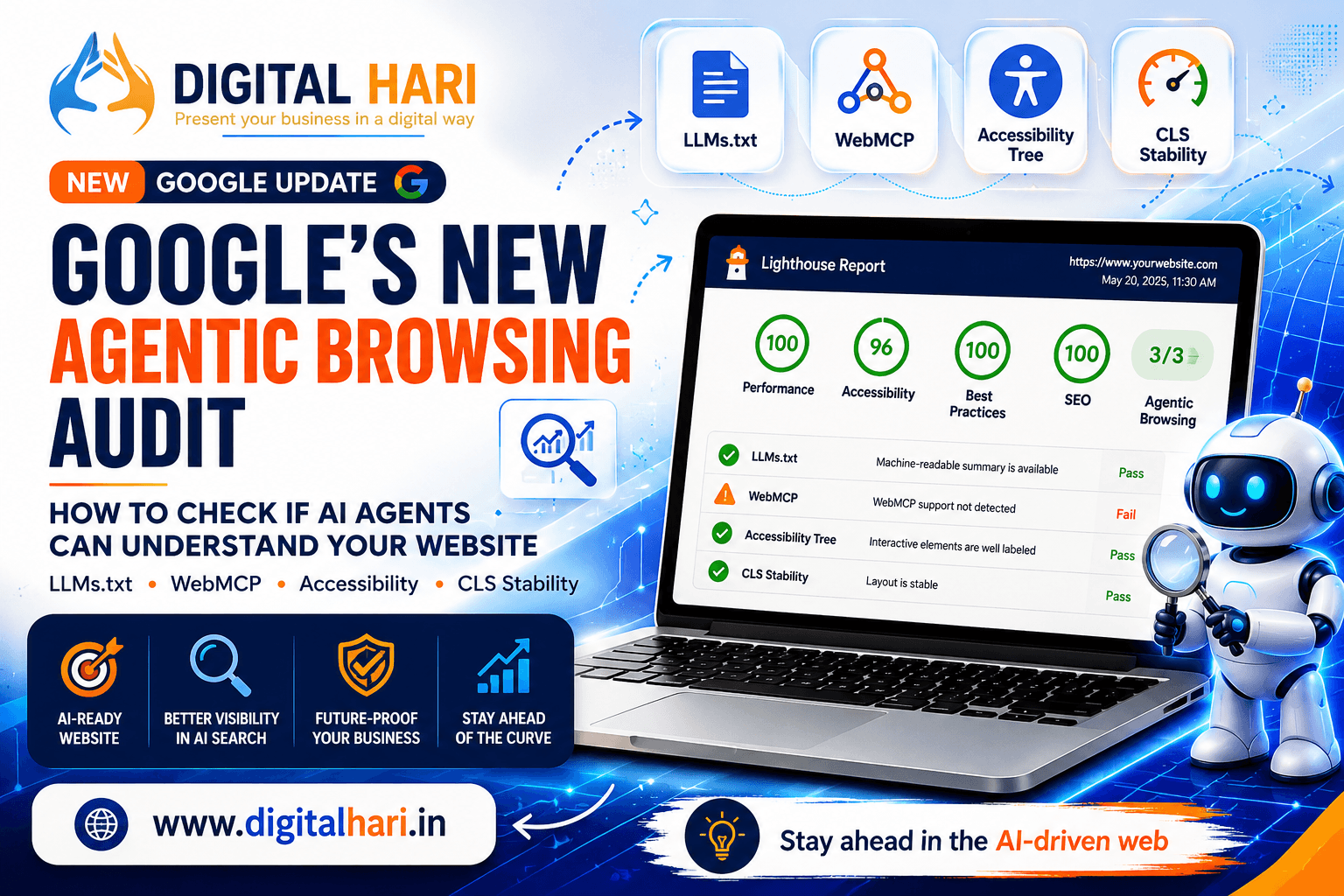
The current experimental version focuses on several areas.
These include:
LLMs.txt
Can AI systems quickly understand what your website is about?
WebMCP
Can AI agents interact with forms and actions on your website?
Accessibility Tree
Can AI systems identify buttons, links, forms, and interactive elements correctly?
Layout Stability (CLS)
Can AI agents reliably interact with page elements without layout shifts causing problems?
These may sound technical.
But they all connect back to one simple idea:
Helping AI systems understand and use websites effectively.
The Screenshot That Caught Attention
One example currently being shared within the SEO community shows a website receiving:
- Performance: 100
- Accessibility: 96
- Best Practices: 100
- SEO: 100
- Agentic Browsing: 3/3
At first glance, it looks like another Lighthouse report.
But the addition of Agentic Browsing changes the conversation.
For the first time, website owners can begin evaluating how AI agents may experience their websites.
Not just human visitors.
Not just search crawlers.
AI agents.
And that is a fascinating development.
Why Website Owners Should Start Paying Attention
It’s important to understand something.
Agentic Browsing is still experimental.
This is not a confirmed ranking factor.
This is not a mandatory optimization requirement.
And businesses should not panic if they see failed audits.
However, according to Hariharan Gandhi, ignoring these developments would also be a mistake.
Many technologies that are considered standard today started as optional experiments.
Examples include:
- Schema Markup
- XML Sitemaps
- Mobile Optimization
- Core Web Vitals
Early adopters often gained advantages before widespread adoption occurred.
Agentic Browsing may follow a similar path.
Or it may evolve into something completely different.
Either way, it’s worth understanding.
The Rise of AI Agents
The bigger story behind Agentic Browsing isn’t the audit itself.
The bigger story is the rise of AI agents.
Increasingly, AI systems are moving beyond simple content generation.
They’re beginning to:
- Browse websites
- Gather information
- Complete actions
- Navigate interfaces
- Perform tasks
For these systems to function effectively, websites need to become easier to understand.
That’s exactly what Google’s new audit is attempting to measure.
And that may provide valuable clues about where the web is heading next.
How to Run Google’s Agentic Browsing Audit
The good news is that testing Agentic Browsing doesn’t require expensive software or complicated setup.
If you’re already using Chrome DevTools and Lighthouse, you’re halfway there.
Since Agentic Browsing is currently experimental, Google hasn’t enabled it for everyone by default yet.
However, anyone curious about AI-ready websites can test it today.
Let’s walk through the process step by step.
Step 1: Update Google Chrome
Before doing anything else, make sure you’re using a recent version of Chrome.
The Agentic Browsing category currently appears in newer builds, particularly Chrome 146+ and experimental releases.
Many website owners may not see the feature immediately because they’re running older versions.
Updating Chrome takes only a few minutes and ensures access to the latest developer tools.
Think of this as unlocking a preview of where website optimization may be heading next.
Step 2: Enable the Agentic Browsing Flag
Google currently hides Agentic Browsing behind an experimental flag.
To enable it:
Open Chrome and visit:
chrome://flags/#enable-webmcp-testing
Locate the setting.
Change it from:
Default
to
Enabled
Then restart Chrome.
After relaunching, Chrome will load with Agentic Browsing support available within Lighthouse.
This process sounds technical, but it’s actually very similar to testing any new Chrome feature before public release.
Step 3: Open Lighthouse
Now visit your website.
Right-click anywhere on the page and select:
Inspect
or press:
F12
This opens Chrome DevTools.
Inside DevTools, locate the:
Lighthouse tab.
Most developers and SEO professionals already use Lighthouse for:
- Performance testing
- SEO audits
- Accessibility reviews
- Core Web Vitals
Now you’ll notice an additional category:
Agentic Browsing
Select it.
Then click:
Analyze Page Load
or
Generate Report
depending on your Chrome version.
The audit may take a few moments to complete.
Step 4: Review the Results
One important thing to understand:
Agentic Browsing does not currently behave like traditional Lighthouse scores.
You won’t see:
- 78/100
- 85/100
- 96/100
Instead, you’ll typically see individual checks that either pass or fail.
Think of it as a readiness checklist rather than a performance score.
And honestly, that’s probably a better approach for an emerging technology.
Understanding the LLMs.txt Audit
One of the first checks focuses on:
LLMs.txt
If you’ve been following recent AI SEO discussions, you’ve probably heard about this file.
An LLMs.txt file acts as a machine-readable summary of your website.
It helps AI systems quickly understand:
- Website purpose
- Core topics
- Important pages
- Key resources
Instead of forcing AI agents to crawl dozens or hundreds of pages, they can gain a high-level understanding immediately.
Google’s documentation specifically mentions that without this file, AI agents may spend more time trying to understand a website’s structure and content.
That statement alone explains why many SEO professionals are paying attention.
Why LLMs.txt Matters for AI Search
Think about how humans browse a website.
Most visitors quickly understand a business by reading:
- Homepage
- About Page
- Services Page
AI systems need a similar shortcut.
An effective LLMs.txt file can act like a roadmap.
For example:
Website: Digital Hari
Purpose:
Digital marketing consulting, SEO, AI search optimization, website development, and lead generation.
Important Pages:
Homepage
Services and service locations
Blog
Contact
Key Topics:
SEO
AI SEO
Google Updates
Local SEO
Website Development
Simple.
Clear.
Machine-readable.
And potentially useful for AI systems.
What Is WebMCP?
This is currently the least understood part of Agentic Browsing.
Even experienced developers are still learning about it.
WebMCP aims to help AI agents interact with websites.
In practical terms, it relates to actions such as:
- Filling forms
- Scheduling appointments
- Completing tasks
- Triggering actions
Imagine a future where an AI assistant could:
“Book a consultation”
or
“Request a quote”
directly on behalf of a user.
For that future to work, websites need standardized ways for AI agents to communicate with them.
That’s where WebMCP enters the picture.
Should You Worry About a Failed WebMCP Audit?
No.
At least not yet.
This is extremely important.
The WebMCP ecosystem is still evolving.
Most websites will currently fail some WebMCP-related checks.
That doesn’t mean your website is broken.
It doesn’t mean your SEO is damaged.
And it definitely doesn’t mean you need to rebuild your website tomorrow.
According to many technical SEO experts, WebMCP should currently be viewed as a future-facing signal rather than an immediate priority.
Understanding the Accessibility Tree Audit
This is where things become much more practical.
And honestly, this may be the most valuable section of the entire Agentic Browsing report.
Accessibility Tree checks whether:
- Buttons have names
- Links are understandable
- Forms contain labels
- Interactive elements have proper roles
This benefits:
- Human visitors
- Screen readers
- Search engines
- AI agents
In other words, fixing accessibility problems improves experiences for everyone.
This is why many accessibility improvements often produce indirect SEO benefits as well.
Example of a Bad Accessibility Setup
Imagine a button that only says:
“Click Here”
AI systems may struggle to understand its purpose.
Now imagine the button says:
“Download Local SEO Checklist”
Much clearer.
Much easier for both humans and AI systems to understand.
The same principle applies across your entire website.
Why CLS Matters for AI Agents
CLS stands for:
Cumulative Layout Shift
It measures how much page elements unexpectedly move while loading.
Many website owners know CLS as a Core Web Vital.
But Agentic Browsing introduces a new perspective.
Imagine an AI agent trying to click:
“Submit”
But a popup appears and shifts the layout.
The button moves.
The click misses.
Task failed.
Humans find this annoying.
AI agents find it equally problematic.
Stable layouts create more reliable interactions for everyone.
The Hidden Lesson Behind These Audits
What’s fascinating is that most Agentic Browsing recommendations aren’t completely new.
Google isn’t asking website owners to reinvent their websites.
Instead, the audits reinforce principles we’ve known for years:
✔ Clear structure
✔ Good accessibility
✔ Stable layouts
✔ Organized information
✔ Better user experience
The difference is that these best practices are now being evaluated through the lens of AI interaction.
And that shift may become increasingly important as AI-driven browsing continues to evolve.
How Agentic Browsing Could Change SEO Forever
If you’ve followed SEO for several years, you’ve probably seen major shifts before.
We moved from:
- Desktop-first to mobile-first
- Keywords to search intent
- Basic backlinks to authority
- Traditional search to AI-powered search
Now another transformation appears to be emerging.
The rise of AI agents.
And Google’s new Agentic Browsing audits may be giving us an early glimpse into what comes next.
According to Hariharan Gandhi, many website owners are still thinking about how search engines interact with websites.
But increasingly, businesses should also think about how AI systems interact with websites.
Those are not always the same thing.
What Exactly Is an AI Agent?
Many people hear the term “AI agent” and immediately think of ChatGPT.
But AI agents go beyond simple chat interfaces.
An AI agent can potentially:
- Visit websites
- Compare products
- Read documentation
- Fill forms
- Schedule appointments
- Collect information
- Complete tasks
Instead of merely answering questions, AI agents can take action.
That’s a significant shift.
Traditional search helped users find information.
AI agents may increasingly help users complete tasks.
And websites need to be prepared for that future.
Why This Matters for Businesses
Let’s imagine a real-world scenario.
A user asks an AI assistant:
“Find me a digital marketing consultant who specializes in AI SEO and schedule a consultation.”
In the future, the AI may:
- Search websites
- Evaluate services
- Compare options
- Fill contact forms
- Request appointments
All without the user manually visiting every website.
If that sounds futuristic, remember how quickly AI search has evolved over the last two years.
What felt impossible in 2023 became common in 2025.
The same may happen with AI agents.
The Connection Between Agentic Browsing, GEO, and AEO
You’ve probably seen new acronyms appearing across the SEO industry:
GEO
Generative Engine Optimization
AEO
Answer Engine Optimization
AISO
AI Search Optimization
While the names differ, the goal is similar.
Helping AI systems:
- Discover content
- Understand content
- Trust content
- Reference content
Google’s Agentic Browsing audits fit naturally into this trend.
Because they focus on making websites easier for AI systems to navigate and understand.
The Businesses That May Benefit First
Not every website will be affected equally.
According to Hariharan Gandhi, several industries may see AI-driven interactions sooner than others.
Examples include:
Local Service Businesses
- Plumbers
- Electricians
- HVAC companies
- Roofers
- Lawyers
- Real estate agencies
Professional Services
- Consultants
- Agencies
- Accountants
- Financial advisors
SaaS Companies
- Software platforms
- CRM providers
- Productivity tools
E-Commerce Stores
- Online retailers
- Product catalogs
- Marketplace sellers
These businesses often rely on website interactions that AI agents may eventually perform.
Practical Fixes You Can Implement Today
The good news?
You don’t need to wait for the future.
Many improvements recommended by Agentic Browsing audits can be implemented immediately.
And they benefit both humans and AI systems.
Improve Accessibility
Start by reviewing:
- Buttons
- Forms
- Navigation menus
- Interactive elements
Ensure everything has:
- Proper labels
- Clear names
- Logical structure
Accessibility improvements often improve usability and SEO at the same time.
Reduce Layout Shifts
Unexpected movement frustrates users.
It also confuses AI agents.
Focus on:
- Stable page layouts
- Optimized images
- Reserved image dimensions
- Reduced popup interference
These improvements support Core Web Vitals and AI interactions.
Organize Content Clearly
AI systems thrive on clarity.
Use:
- Descriptive headings
- Logical sections
- Clear navigation
- Topic-focused content
Avoid creating pages that jump between unrelated subjects.
Build Topical Authority
This remains one of the most powerful SEO strategies available.
For example, if your website focuses on SEO, create content around:
- Technical SEO
- Local SEO
- AI SEO
- Google Updates
- Content Strategy
- Search Intent
Comprehensive topic coverage helps both search engines and AI systems understand expertise.
Common Mistakes Businesses Are Making
As AI becomes more popular, many businesses are making the same mistakes.
Chasing Every New Trend
Some website owners immediately assume:
“New AI feature = urgent SEO requirement.”
That’s rarely true.
Agentic Browsing is still experimental.
LLMs.txt is still evolving.
WebMCP is still developing.
Businesses should stay informed without overreacting.
Ignoring AI Search Completely
The opposite mistake is equally dangerous.
Some businesses dismiss every AI-related development.
That approach may become risky.
AI search isn’t a future concept anymore.
It’s already influencing how people discover information.
Forgetting SEO Fundamentals
No AI optimization can replace:
- Quality content
- Strong SEO
- Good user experience
- Fast websites
- Authority building
These fundamentals remain essential.
Always.
Hariharan Gandhi’s Perspective
According to Hariharan Gandhi, the biggest lesson from Agentic Browsing is not about scores.
It’s about awareness.
The Lighthouse report is essentially asking a new question:
“Can AI systems successfully use your website?”
That question barely existed a few years ago.
Today it’s becoming increasingly relevant.
Whether Agentic Browsing becomes a permanent Lighthouse category or evolves into something else, the underlying trend is clear.
Websites are being evaluated by more than just human visitors and search crawlers.
AI systems are becoming participants too.
And businesses that understand this shift early may gain a meaningful advantage.
The Future of SEO Is Expanding
SEO isn’t disappearing.
It’s expanding.
Traditional optimization remains important.
But a new layer is emerging.
The future may involve optimizing for:
✔ Search engines
✔ Human visitors
✔ AI assistants
✔ AI agents
✔ Answer engines
✔ Generative search experiences
That’s a much broader ecosystem than most businesses have dealt with before.
And Agentic Browsing may be one of the first practical tools helping website owners prepare for it.
Final Thoughts
Google’s new Agentic Browsing audits may not seem revolutionary today.
They’re experimental.
They’re evolving.
And some parts, like WebMCP, are still very early.
But the bigger message is difficult to ignore.
Google is actively exploring how AI agents interact with websites.
That alone should capture the attention of marketers, developers, business owners, and SEO professionals.
According to Hariharan Gandhi, the websites that succeed in the next phase of digital marketing won’t simply be optimized for rankings.
They’ll be optimized for understanding, interaction, and usability across both humans and AI systems.
The agentic web is no longer a future prediction.
It’s already appearing inside the tools many of us use every day.
And that makes this one of the most important SEO developments to watch right now.
Frequently Asked Questions About Google’s Agentic Browsing Audit and AI SEO
1. What is Google's Agentic Browsing Audit?
Agentic Browsing is a new experimental Lighthouse category introduced by Google that evaluates whether AI agents can successfully understand, navigate, and interact with your website. It focuses on AI readiness rather than traditional SEO metrics.
2. Why did Google introduce Agentic Browsing?
Google introduced Agentic Browsing to help developers and website owners understand how AI agents interact with websites. As AI-powered assistants become more common, websites need to be accessible not only to users and search engines but also to AI systems.
3. Is Agentic Browsing a Google ranking factor?
No. At the time of writing, Agentic Browsing is not a ranking factor. It is an experimental Lighthouse audit designed to assess AI agent compatibility and website usability.
4. How can I access the Agentic Browsing audit?
You need a recent version of Google Chrome, enable the WebMCP testing flag, and run Lighthouse from Chrome DevTools. Once enabled, the Agentic Browsing category will appear alongside Performance, Accessibility, Best Practices, and SEO.
5. What does the Agentic Browsing audit check?
The audit currently evaluates several areas, including: LLMs.txt availability WebMCP support Accessibility Tree quality Cumulative Layout Shift (CLS) Website interaction readiness for AI agents
6. What is LLMs.txt?
LLMs.txt is an emerging protocol designed to help AI agents understand a website's primary content, key topics, important pages, and overall purpose through a machine-readable summary.
7. Does LLMs.txt improve SEO rankings?
Currently, there is no evidence that LLMs.txt directly improves Google rankings. However, it may help AI systems understand website content more efficiently, making it relevant for AI Search Optimization.
8. What is WebMCP?
WebMCP is an emerging framework that aims to help AI agents interact with websites, complete tasks, submit forms, and perform actions more effectively. The standard is still evolving and not yet widely adopted.
9. Why does the WebMCP audit fail on many websites?
Because WebMCP is still experimental, most websites currently do not support it. A failed WebMCP audit does not indicate an SEO problem and should not be a cause for concern at this stage.
10. What is the Accessibility Tree and why is it important?
The Accessibility Tree helps browsers, screen readers, and AI systems understand website elements such as buttons, forms, links, and menus. Proper accessibility improves usability for both humans and AI agents.
11. How does CLS affect AI agents?
CLS (Cumulative Layout Shift) measures unexpected page movement during loading. Excessive layout shifts can confuse AI agents and users by causing buttons or interactive elements to move unexpectedly.
12. Can small business websites benefit from Agentic Browsing optimization?
Yes. While advanced features like WebMCP may not be necessary yet, improvements in accessibility, content structure, page stability, and user experience benefit all websites regardless of size.
13. What is the difference between traditional SEO and Agentic SEO?
Traditional SEO focuses on helping search engines crawl, index, and rank content. Agentic SEO focuses on helping AI systems understand, navigate, and interact with website content effectively.
14. How does Agentic Browsing relate to AI SEO, GEO, and AEO?
Agentic Browsing aligns closely with: AI Search Optimization (AISO) Generative Engine Optimization (GEO) Answer Engine Optimization (AEO) All of these approaches focus on improving visibility and understanding within AI-powered search and answer systems.
15. Should website owners start preparing for AI agents now?
According to Hariharan Gandhi, the answer is yes. Businesses do not need to panic or overhaul their websites, but they should begin improving content clarity, accessibility, site structure, and AI-readability to prepare for the future of search.
16. Will AI agents replace traditional search engines?
Not entirely. Traditional search engines will continue to play an important role. However, AI-powered assistants, answer engines, and agent-based browsing experiences are expected to become a significant part of how users discover and interact with information online.
17. What is the biggest takeaway from Google's Agentic Browsing audit?
The biggest takeaway is that the future of website optimization is expanding beyond search engines. Websites will increasingly need to serve human visitors, search crawlers, AI assistants, and AI agents simultaneously. Businesses that prepare early may gain a competitive advantage as AI-driven search continues to evolve.