
For years, website owners have been optimizing their websites primarily for search engines.
The process was relatively straightforward.
Create quality content. Optimize pages. Build authority. Help search engines crawl and understand your website.
Tools such as robots.txt, XML sitemaps, structured data, and internal linking became standard parts of modern SEO.
But search is changing rapidly.
Today, websites are no longer being discovered only by traditional search engines like Google and Bing.
Increasingly, content is being accessed, analyzed, summarized, and recommended by AI systems such as ChatGPT, Gemini, Claude, Perplexity, and other large language model (LLM) powered platforms.
This shift has created a new challenge.
How can AI systems quickly understand what a website is about without crawling hundreds or thousands of pages?
That question has led to growing interest in something called llms.txt.
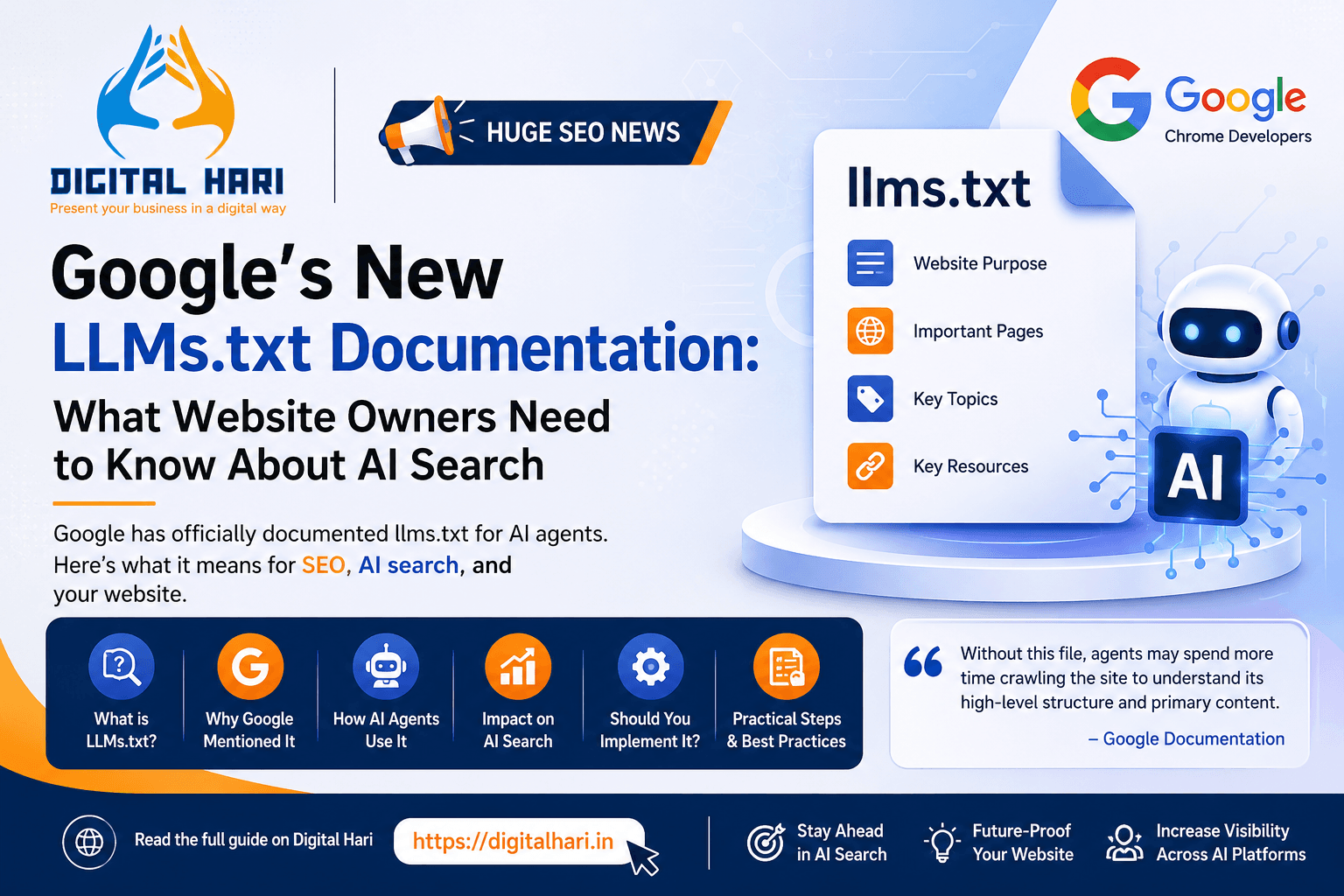
Recently, Google quietly added documentation related to llms.txt within Chrome Developer documentation and Lighthouse auditing resources.
While Google has not officially stated that llms.txt is a ranking factor or an SEO requirement, the fact that Google is now documenting it has captured the attention of SEO professionals worldwide.
According to Hariharan Gandhi from Digital Hari, this may be one of the most interesting AI-related developments website owners should monitor in 2026.
Not because llms.txt will suddenly boost rankings.
But because it provides insight into how AI systems may understand websites in the future.
What Exactly Is LLMs.txt?
To understand llms.txt, let’s start with something familiar.
Most website owners know about robots.txt.
A robots.txt file helps search engine crawlers understand which parts of a website can or cannot be accessed.
Similarly, XML sitemaps help search engines discover important pages.
LLMs.txt serves a different purpose.
Instead of controlling crawler behavior, llms.txt is designed to help AI systems understand the most important information about a website.
Think of it as a concise guide created specifically for AI agents.
An llms.txt file can contain:
- Website purpose
- Main topics
- Important sections
- Key resources
- Priority pages
- Documentation links
- Contact information
- Product information
In simple terms, llms.txt acts like an executive summary for AI systems.
Instead of forcing an AI model to crawl hundreds of pages to understand your website, the AI can quickly read the llms.txt file and gain a high-level understanding of your content.
According to the emerging specification, the file is typically placed in the root directory of a website:
example.com/llms.txt
This makes it easy for AI systems to locate and interpret.
Why Is Everyone Suddenly Talking About LLMs.txt?
The concept itself is not entirely new.
However, interest exploded when Google documentation started mentioning it.
In the Chrome Developer documentation, Google describes llms.txt as an emerging convention designed to provide machine-readable summaries of website content specifically for AI agents and large language models.
One particular statement attracted attention across the SEO community:
“Without this file, agents may spend more time crawling the site to understand its high-level structure and primary content.”
That sentence immediately sparked discussions among marketers, developers, and SEO professionals.
Why?
Because it indirectly acknowledges a challenge many AI systems face today.
Modern websites can be enormous.
Some websites contain:
- Thousands of blog posts
- Product catalogs
- Support documentation
- Resource centers
- Landing pages
- Knowledge bases
Understanding all of that content efficiently is difficult.
An llms.txt file may provide a shortcut.
And according to Hariharan Gandhi, that is what makes this development worth watching.
Does Google Recommend Using LLMs.txt?
This is where many people are becoming confused.
The answer is:
Not officially.
Google has not announced:
- Ranking benefits
- Indexing advantages
- SEO improvements
- Search visibility boosts
In fact, Google’s documentation currently presents llms.txt as an optional emerging convention.
The documentation even notes that if a website does not provide an llms.txt file, the audit is marked as “Not Applicable.”
That is important.
It means website owners should avoid assuming that llms.txt is suddenly required.
According to Digital Hari, treating llms.txt as a guaranteed ranking factor would be a mistake.
Instead, it should be viewed as an emerging technology that may become increasingly useful as AI-driven search continues to evolve.
Why This Matters More Than Many Businesses Realize
Many website owners are still focused entirely on traditional SEO.
And traditional SEO remains important.
However, search behavior is changing.
People are increasingly asking questions directly to AI platforms.
Instead of searching:
“best CRM software”
Users may ask:
“What CRM software is best for a small business with under 10 employees?”
Instead of searching:
“how to improve local seo”
Users may ask:
“What are the easiest local SEO improvements a small business can make in 2026?”
AI systems then generate answers based on their understanding of available information.
This creates a new challenge for website owners.
The goal is no longer only ranking in search results.
The goal is becoming understandable to AI systems.
And that is exactly where concepts like llms.txt become interesting.
According to Hariharan Gandhi from Digital Hari, businesses should start thinking beyond traditional search rankings and begin considering how AI systems interpret website content.
Because AI visibility may become just as important as search visibility over the next few years.
The Bigger Shift Behind LLMs.txt
The most important takeaway is not the file itself.
The bigger story is what it represents.
For years, SEO focused on helping search engines understand websites.
Now a new layer is emerging:
Helping AI systems understand websites.
That distinction may seem small today.
But it could become one of the biggest changes in digital marketing over the next decade.
The rise of AI search, AI assistants, AI overviews, and conversational search experiences is creating entirely new opportunities for businesses that adapt early.
And llms.txt may be one small piece of that future.
How Does LLMs.txt Actually Work?
One of the biggest questions website owners are asking right now is:
“If llms.txt is not a ranking factor, what exactly does it do?”
The simplest answer is this:
LLMs.txt is designed to help AI systems understand a website faster.
Think about how humans visit a website.
A visitor can usually understand a business within a few minutes by reading:
- The homepage
- About page
- Services page
- Main navigation
AI systems often need to do something similar.
However, instead of visually browsing pages like humans, they process website content programmatically.
On large websites, that can require significant crawling and analysis.
According to the emerging llms.txt concept, website owners can provide a concise summary that explains:
- Who they are
- What they do
- Which pages matter most
- Which resources should be prioritized
This can potentially reduce the effort required for AI systems to understand a website’s overall structure.
A Simple Example of an LLMs.txt File
Many website owners imagine llms.txt as a complicated technical file.
In reality, it is surprisingly simple.
A basic example could look something like this:
Website: Digital Hari
Purpose:
Digital marketing consulting focused on SEO, AI search optimization, website development, local SEO, and lead generation.
Important Pages:
https://digitalhari.in/
https://digitalhari.in/services/
https://digitalhari.in/blog/
https://digitalhari.in/contact/
Key Topics:
SEO
AI Search
Google Updates
Local SEO
Website Design
Digital Marketing
Contact:
https://digitalhari.in/contact/
This example is intentionally simple.
The goal is clarity, not complexity.
According to Hariharan Gandhi from Digital Hari, many website owners make the mistake of assuming AI optimization requires complicated technical solutions.
Often, simplicity works better.
Is LLMs.txt Similar to Robots.txt?
Not exactly.
This is one of the most common misconceptions currently circulating online.
Robots.txt helps crawlers understand:
- What they can access
- What they cannot access
LLMs.txt serves a different purpose.
It helps AI systems understand:
- Website context
- Content priorities
- Topic focus
- Important resources
In simple terms:
Robots.txt controls access.
LLMs.txt provides understanding.
The two files serve completely different functions.
Is LLMs.txt Similar to XML Sitemaps?
Again, not exactly.
XML sitemaps help search engines discover URLs.
LLMs.txt helps AI systems understand meaning.
A sitemap answers:
“What pages exist?”
An llms.txt file attempts to answer:
“What is this website about?”
Both are useful.
But they solve different problems.
Should Small Businesses Create an LLMs.txt File?
This is probably the most important practical question.
And honestly, there is no universal answer.
According to Hariharan Gandhi, the answer depends on the size and complexity of the website.
For example:
Businesses That May Benefit Earlier
- SaaS companies
- Large blogs
- Documentation websites
- Knowledge bases
- E-commerce stores
- Educational platforms
These websites often contain hundreds or thousands of pages.
Helping AI systems understand the most important content could be valuable.
Businesses That Can Wait
- Small brochure websites
- New websites
- Simple service websites
- Local businesses with limited content
For these websites, other SEO priorities remain far more important.
Examples include:
- Content quality
- Technical SEO
- Internal linking
- Local SEO
- User experience
Digital Hari recommends focusing on these fundamentals before worrying about emerging AI protocols.
The Real Opportunity Is Not the File
This is where many discussions about llms.txt become misleading.
People become obsessed with the file itself.
But the file is not the real story.
The real story is that Google is openly acknowledging the growing importance of AI-focused website understanding.
That is the bigger takeaway.
According to Hariharan Gandhi, businesses should pay attention not because llms.txt guarantees results.
But because it signals where search may be heading next.
The Rise of AI Search Optimization
Traditional SEO focused on helping search engines understand pages.
AI Search Optimization focuses on helping AI systems understand meaning.
This includes:
- Clear content structure
- Topical authority
- Internal linking
- Entity relationships
- Conversational content
- Helpful explanations
These concepts already influence modern SEO.
And they may become even more important as AI search evolves.
Why This Matters for ChatGPT, Gemini and Perplexity
Many website owners still think only about Google rankings.
But visibility today extends beyond traditional search.
Users increasingly discover information through:
- ChatGPT
- Gemini
- Perplexity
- AI Overviews
- AI assistants
These systems need efficient ways to understand websites.
That is why structured content matters.
That is why topical authority matters.
And that is why emerging concepts like llms.txt are attracting attention.
Whether the protocol becomes mainstream or not, the underlying goal remains the same:
Making websites easier for AI systems to understand.
Common Misconceptions About LLMs.txt
Let’s clear up some myths.
Myth 1: LLMs.txt Improves Rankings
There is currently no evidence that llms.txt improves Google rankings.
Google has not made that claim.
Myth 2: Every Website Needs It Immediately
Not true.
Many websites will see greater benefits by improving content quality and technical SEO first.
Myth 3: LLMs.txt Replaces SEO
Absolutely not.
SEO fundamentals remain essential.
Content quality still matters.
Authority still matters.
User experience still matters.
Myth 4: LLMs.txt Replaces Robots.txt
They serve completely different purposes.
Both can coexist.
Digital Hari’s Perspective
According to Hariharan Gandhi from Digital Hari, website owners should avoid two extremes.
The first mistake is ignoring AI search completely.
The second mistake is chasing every new trend without understanding it.
A balanced approach works best.
Monitor developments.
Understand emerging technologies.
But continue focusing on proven SEO fundamentals.
Because regardless of how AI evolves, websites that provide:
- Clear information
- Helpful content
- Strong authority
- Excellent user experience
Will continue to perform well.
Will LLMs.txt Become the Next Robots.txt?
This is probably the biggest question surrounding llms.txt right now.
And honestly, nobody knows for certain.
The protocol is still emerging.
Adoption is still limited.
And there is currently no official requirement from Google to implement it.
However, history provides an interesting lesson.
Many SEO technologies started as optional concepts.
For example:
- XML Sitemaps
- Schema Markup
- Open Graph Tags
- Canonical Tags
When these technologies first appeared, many website owners ignored them.
Years later, they became standard best practices.
According to Hariharan Gandhi from Digital Hari, it would be unwise to dismiss llms.txt entirely simply because it is new.
That does not mean every business needs to implement it today.
But it does mean website owners should understand it and monitor its evolution.
Because if AI search continues growing at its current pace, structured AI-readable website summaries may eventually become much more important.
Why Google’s Documentation Matters
Some people argue:
“Google isn’t recommending llms.txt, so why should anyone care?”
That argument misses an important point.
The real news is not whether Google recommends the file.
The real news is that Google chose to document it at all.
According to Hariharan Gandhi, Google’s documentation serves as a signal.
It indicates that AI agents and large language models are becoming increasingly relevant to how information is discovered online.
For years, website owners focused almost exclusively on helping search engines understand websites.
Now the conversation is expanding to include AI systems.
That shift alone is significant.
The Future of AI SEO
One thing is becoming increasingly clear.
SEO is evolving.
Traditional SEO focused heavily on:
- Keywords
- Rankings
- Backlinks
- Crawling
- Indexing
Those fundamentals remain important.
But AI search introduces additional layers.
Businesses now need to think about:
- Content clarity
- Topical authority
- Entity relationships
- Contextual understanding
- Conversational relevance
This is why many experts now discuss concepts such as:
- AI Search Optimization (AISO)
- Generative Engine Optimization (GEO)
- Answer Engine Optimization (AEO)
Regardless of what terminology becomes popular, the underlying goal remains the same:
Make information easier for AI systems to understand.
And llms.txt fits naturally into that broader conversation.
How Digital Hari Would Approach LLMs.txt
If a client asked whether they should implement llms.txt today, the recommendation would not simply be “yes” or “no.”
Instead, the decision would depend on the website.
For example:
High Priority Candidates
- Large content publishers
- SaaS companies
- Documentation platforms
- Educational websites
- E-commerce stores with extensive catalogs
These websites contain large amounts of information and could potentially benefit from helping AI systems identify important content faster.
Lower Priority Candidates
- Small local business websites
- New websites
- Simple service websites
- Landing-page-focused websites
For these businesses, Digital Hari would still prioritize:
- SEO fundamentals
- Technical optimization
- Content quality
- User experience
- Internal linking
- Topical authority
Before worrying about emerging AI protocols.
The Bigger Lesson Website Owners Should Learn
One of the most valuable lessons from this development has nothing to do with the file itself.
The bigger lesson is that website owners need to start thinking beyond traditional search.
For years, success meant:
“How do I rank on Google?”
Today, the question is expanding into:
“How do I become understandable to AI systems?”
That distinction may become increasingly important over the next few years.
Because users are no longer discovering information exclusively through search results.
They are also discovering information through:
- AI Overviews
- ChatGPT
- Gemini
- Perplexity
- AI assistants
- Voice search platforms
The websites that adapt early to this reality may gain a significant advantage.
Practical AI Search Checklist for Website Owners
Regardless of whether you create an llms.txt file today, these are practical actions every website owner should consider:
Improve Content Clarity
Write content that is easy to understand.
Avoid unnecessary jargon.
Use clear headings and logical structure.
Build Topical Authority
Cover subjects comprehensively.
Connect related topics naturally.
Create content clusters instead of isolated articles.
Strengthen Internal Linking
Help both users and AI systems understand relationships between content.
Use Structured Data
Schema markup continues to provide valuable context.
Create Helpful Content
Focus on solving problems rather than chasing algorithms.
Monitor Emerging AI Standards
Stay informed about developments such as:
- llms.txt
- AI search optimization
- Answer engines
- Generative search
The businesses that stay informed usually adapt faster.
Hariharan Gandhi’s Final Thoughts
According to Hariharan Gandhi, the most important takeaway from Google’s llms.txt documentation is not the file itself.
The bigger takeaway is the direction of the industry.
Search is becoming more AI-driven.
Content discovery is becoming more conversational.
And website owners increasingly need to think about how machines understand information.
Whether llms.txt becomes a widely adopted standard or remains a niche protocol is still unknown.
But one thing is clear.
The future of digital marketing will not be defined solely by rankings.
It will increasingly be influenced by understanding.
Understanding content.
Understanding context.
Understanding user intent.
And helping AI systems understand websites more effectively.
Conclusion
Google’s new documentation around llms.txt may not change SEO overnight.
It may not improve rankings.
It may not become mandatory.
But it represents something important.
It represents Google’s recognition that AI systems need efficient ways to understand websites.
For website owners, marketers, SEO professionals, and business leaders, that is the real story.
According to Hariharan Gandhi from Digital Hari, the businesses that succeed in the next phase of search will not simply optimize for crawlers.
They will optimize for understanding.
Because the future of SEO is no longer just about helping search engines find content.
It’s about helping AI systems understand it.
And that future may already be closer than many people realize.
Frequently Asked Questions About Google’s LLMs.txt Documentation
What is LLMs.txt?
LLMs.txt is an emerging protocol designed to help AI systems understand a website's primary content, important pages, and overall structure more efficiently. It acts as a high-level guide for AI agents and large language models.
Has Google officially recommended LLMs.txt for SEO?
No. Google has not recommended LLMs.txt as a ranking factor or SEO requirement. However, Google has published documentation discussing the protocol and its potential use for AI agents.
Does LLMs.txt improve Google rankings?
Currently, there is no evidence that LLMs.txt directly improves search rankings. Website owners should not treat it as a ranking signal or replacement for traditional SEO best practices.
Why is Google's LLMs.txt documentation important?
According to Hariharan Gandhi from Digital Hari, the importance is not the file itself but what it represents. It shows that AI systems are becoming increasingly important in how information is discovered and understood online.
How is LLMs.txt different from Robots.txt?
Robots.txt controls crawler access to website content. LLMs.txt helps AI systems understand website content and structure. Both files serve completely different purposes and can coexist.
Is LLMs.txt the same as an XML Sitemap?
No. An XML sitemap helps search engines discover pages. LLMs.txt helps AI systems understand what a website is about and which content is most important.
Should small businesses create an LLMs.txt file?
For most small business websites, LLMs.txt is not an urgent priority. According to Digital Hari, businesses should focus first on content quality, technical SEO, local SEO, user experience, and topical authority.
Which websites may benefit most from LLMs.txt?
Websites with large amounts of content may potentially benefit more, including: SaaS platforms Documentation websites Educational portals Large blogs E-commerce stores Knowledge bases
How does LLMs.txt relate to AI Search Optimization?
LLMs.txt aligns with the broader goal of helping AI systems understand websites more efficiently. It supports concepts related to AI Search Optimization (AISO), Answer Engine Optimization (AEO), and Generative Engine Optimization (GEO).
Will LLMs.txt become an industry standard?
It is too early to know. However, according to Hariharan Gandhi, website owners should monitor its development because many SEO technologies that seem optional today often become common best practices over time.
What is the biggest takeaway from Google's LLMs.txt documentation?
The biggest takeaway is that search is becoming increasingly AI-driven. Businesses should start thinking not only about how search engines crawl websites, but also how AI systems understand and interpret website content.