
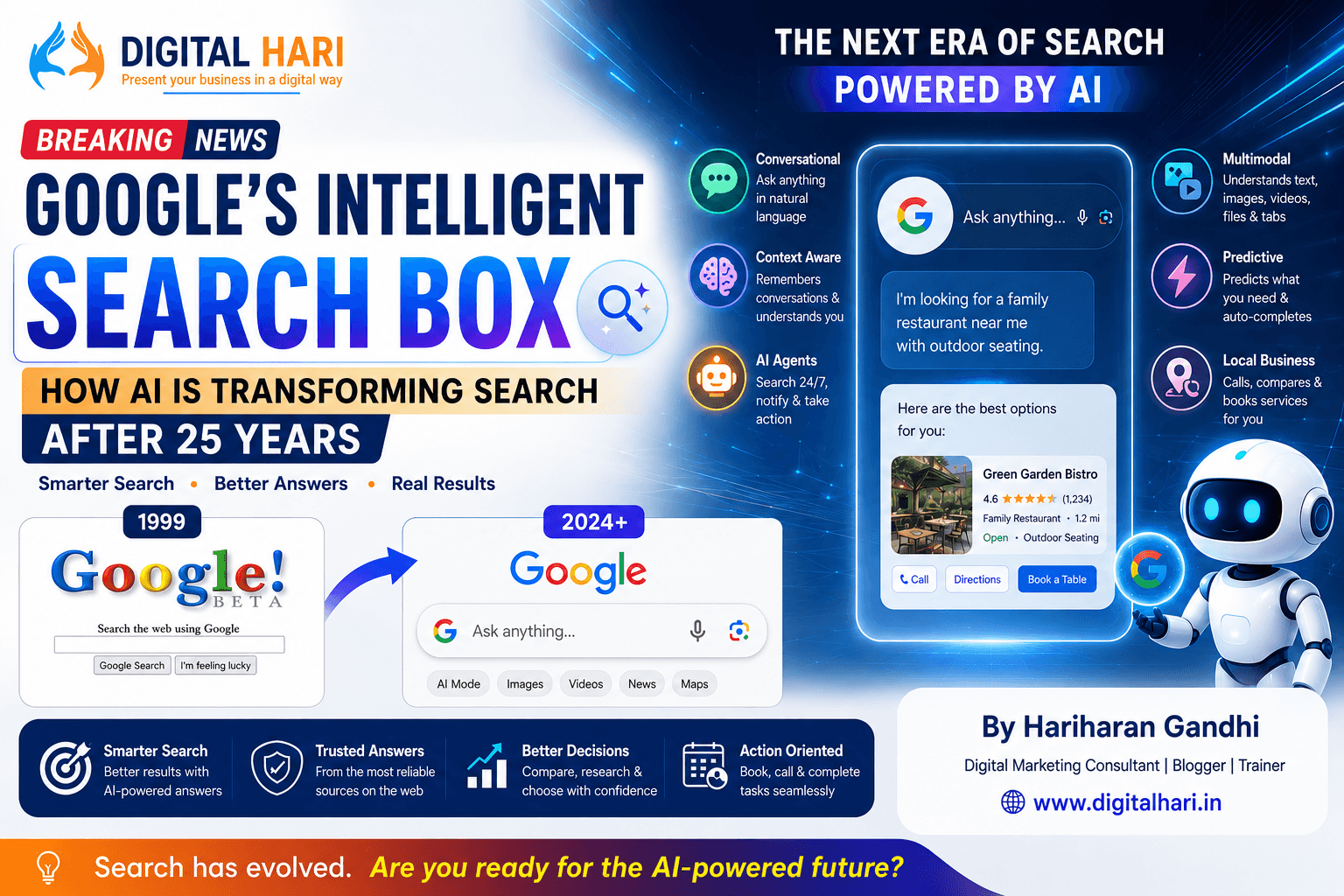
For more than two decades, searching on Google followed a familiar pattern.
You opened the search engine, typed a few keywords, pressed Enter, and browsed through a list of blue links.
Whether you were looking for a nearby restaurant, the latest smartphone, or an answer to a technical question, the process remained largely unchanged.
But that era is rapidly evolving.
Google is introducing a new generation of AI-powered search experiences that go far beyond traditional keyword searches. With conversational interactions, context-aware responses, multimodal capabilities, and AI agents that can perform tasks on behalf of users, search is becoming more intelligent than ever before.
According to Hariharan Gandhi, this isn’t just another product update—it represents one of the biggest transformations in online search since Google’s early days.
For website owners, global freelance digital marketers, businesses, and SEO professionals, understanding this shift is no longer optional. It is essential for staying competitive in the age of AI.
From Simple Search Box to Intelligent Assistant
Take a moment to compare Google’s homepage from the late 1990s with what users experience today.
Back then, Google offered a clean interface with one purpose:
Search the web.
Users entered short keyword phrases like:
- best laptop
- digital camera
- weather today
- nearby hotels
Google matched those words with indexed web pages and displayed a ranked list of results.
Today, the experience is changing dramatically.
Instead of typing fragmented keywords, users can ask complete questions such as:
“I’m planning a family vacation to Florida next month with two children under 10. Can you suggest affordable hotels near Disney World with free breakfast and good reviews?”
The search engine understands the context, processes the intent, and generates an intelligent response.
This marks a major shift from keyword-based searching to conversation-driven discovery.
Why This Is One of the Biggest Search Changes in 25 Years
The introduction of AI-powered search isn’t simply about adding chatbot features.
It fundamentally changes how users interact with information.
For decades, people searched for websites.
Increasingly, people are now searching for answers.
Instead of manually opening multiple pages, comparing information, and making decisions, AI can summarize content, compare options, and guide users toward the best solution.
According to Hariharan Gandhi, this shift means businesses must think beyond ranking positions.
The new goal is becoming a trusted source that AI systems choose to reference.
In many cases, users may never click through dozens of search results.
They may rely on AI-generated summaries instead.
That makes content quality and authority more important than ever.
Search Is Becoming Conversational
One of the most exciting aspects of Google’s AI-powered search experience is conversational interaction.
Rather than restarting every search from scratch, users can continue asking follow-up questions naturally.
For example:
User:
“What are the best laptops for graphic design?”
Google responds.
The user then asks:
“Which one has the best battery life under $1,500?”
No need to repeat the original query.
The AI remembers the context and continues the conversation.
This mirrors how humans naturally communicate.
And it creates a smoother, more intuitive search experience.
Goodbye Keyword Stuffing, Hello Intent
For many years, some websites tried to manipulate rankings by repeating keywords excessively.
Modern AI search changes that equation.
Today’s systems are designed to understand:
- Context
- Intent
- Relationships between topics
- Natural language
- User goals
That means businesses should focus on creating genuinely helpful content rather than forcing exact-match keywords into every paragraph.
According to Hariharan Gandhi, websites that answer real questions in a clear and comprehensive manner are more likely to succeed in both traditional SEO and AI-powered search.
AI Understands More Than Just Text
Another significant advancement is multimodal understanding.
Google’s AI is no longer limited to written queries.
Users can interact using:
- Text
- Images
- Videos
- Documents
- Voice
- Screenshots
- Browser tabs
Imagine uploading a picture of a broken appliance and asking:
“Can this be repaired, or should I replace it?”
Or sharing a PDF and asking:
“Summarize the key points in simple language.”
These capabilities transform Google from a search engine into an intelligent assistant capable of understanding multiple types of information simultaneously.
Why This Matters for Businesses
Many businesses still optimize their websites as if users only search using short keywords.
However, conversational AI changes customer behavior.
Potential customers now ask highly detailed questions that include:
- Budgets
- Preferences
- Locations
- Previous interactions
- Specific requirements
For example:
“Find a web design agency in Texas that specializes in local SEO for plumbing companies and offers affordable monthly plans.”
That’s far more specific than simply searching for:
“web design Texas”
Businesses that create comprehensive, well-structured content are more likely to appear in these AI-driven responses.
The Evolution of SEO
SEO itself is evolving alongside search.
Traditional optimization focused heavily on:
- Keywords
- Backlinks
- Technical SEO
- Meta tags
Those elements remain valuable.
But AI search introduces additional priorities.
Content should now demonstrate:
- Expertise
- Authority
- Trustworthiness
- Clarity
- Topical depth
- Helpful explanations
According to Hariharan Gandhi, the websites that educate users thoroughly are likely to have a competitive advantage as AI systems become more influential.
A New Era Has Begun
The familiar Google search box isn’t disappearing.
Instead, it is becoming significantly smarter.
It is evolving from a simple tool that retrieves web pages into an assistant capable of understanding conversations, remembering context, and helping users complete tasks more efficiently.
For businesses, this signals an important opportunity.
Those who adapt early by producing high-quality, user-focused content will be better positioned for the future of AI-powered search.
AI Agents: The Biggest Change Most People Haven’t Fully Understood
When people hear the phrase “AI-powered search,” they often imagine a smarter chatbot that answers questions more naturally.
But Google’s latest innovations point toward something much bigger.
Instead of simply answering your questions, AI systems are gradually becoming capable of taking action on your behalf.
This is where AI agents enter the picture.
According to Hariharan Gandhi, AI agents could become one of the most transformative technologies for businesses and consumers over the next decade.
Rather than acting as passive assistants, they may function as digital representatives that research, compare, recommend, and even complete tasks automatically.
Search That Never Sleeps
Imagine you’re planning to buy a new laptop.
Instead of manually checking prices every day, comparing specifications, and monitoring discounts across dozens of websites, you simply tell Google:
“Notify me when a laptop with an Intel Core Ultra processor, 32GB RAM, and under $1,200 becomes available.”
The AI agent continues searching in the background.
It monitors websites continuously.
When it finds a matching option, it alerts you automatically.
This changes search from a one-time activity into an ongoing service.
Instead of searching repeatedly, the AI works for you.
Your Search History Becomes Context
Traditional search engines treated every query independently.
For example:
You search:
“Best DSLR cameras.”
Then search again:
“Which one is best for wildlife photography?”
Previously, Google relied on your second query alone.
Modern AI-powered search changes this experience.
It remembers the previous conversation and understands that “which one” refers to the DSLR cameras already discussed.
This creates a far more natural interaction.
According to Hariharan Gandhi, context-aware search represents one of the biggest usability improvements introduced by AI.
Users no longer need to repeat themselves constantly.
The conversation simply continues.
Follow-Up Questions Feel Human
The ability to ask follow-up questions naturally is changing how people interact with search.
For example:
User:
What are the best website builders for small businesses in Malaysia?
AI Response:
Provides several recommendations.
User:
Which one offers the best SEO features?
AI Response:
Compares SEO capabilities.
User:
Which is the most affordable for startups?
Again, the AI understands the conversation without requiring the user to restate the topic.
This mirrors natural human dialogue.
And it significantly reduces friction.
Predictive Search Gets Smarter
Autocomplete has existed for years.
But AI-powered prediction goes much further.
Instead of merely guessing what you’re typing, Google’s intelligent search can anticipate what information you’re likely seeking based on:
- Previous searches
- Current conversation
- Location
- Preferences
- Intent
For example, while planning a holiday, the system might proactively suggest:
- Flights
- Hotels
- Local attractions
- Transportation
- Travel insurance
All before you explicitly ask.
This creates a more personalized experience that feels less like searching and more like receiving assistance.
AI Can Understand More Than Words
One of the most impressive developments is multimodal understanding.
Google’s AI isn’t limited to text.
It can increasingly interpret:
- Images
- Videos
- PDFs
- Documents
- Screenshots
- Browser tabs
- Voice input
Imagine uploading a screenshot of a software error and asking:
“Why is this happening, and how do I fix it?”
Or uploading a spreadsheet and requesting:
“Summarize the sales trends from this data.”
These capabilities dramatically expand how users interact with search.
According to Hariharan Gandhi, businesses should begin creating content that supports multiple content formats, not just written articles.
AI Search Is Becoming Personal
Another important change is personalization.
Future AI systems will increasingly consider:
- User preferences
- Previous conversations
- Frequently visited websites
- Location
- Interests
This means two people asking similar questions may receive different recommendations based on their unique needs.
For businesses, personalization raises the importance of trust and reputation.
AI systems are more likely to recommend brands that demonstrate expertise, authority, and consistent quality.
Why Local Businesses Should Pay Attention
Perhaps one of the biggest opportunities lies in local search.
Traditionally, users searched:
“Best plumber near me.”
Then visited websites individually.
Compared reviews.
Made phone calls.
Requested quotes.
Future AI systems may simplify that entire process.
Imagine asking:
“Find the highest-rated emergency plumber available within 10 miles and book an appointment tomorrow morning.”
The AI could:
- Compare businesses
- Check availability
- Contact providers
- Present options
- Assist with scheduling
For local businesses, visibility may increasingly depend on how easily AI systems can understand services and business information.
AI Search Rewards Clarity
One trend becomes increasingly obvious across all these developments.
AI performs best when information is clear.
Businesses should avoid:
- Confusing navigation
- Poorly structured pages
- Vague service descriptions
- Thin content
Instead, websites should provide:
- Clear headings
- Comprehensive explanations
- Logical organization
- Accurate information
- Easy-to-understand language
These improvements benefit both human visitors and AI systems simultaneously.
What This Means for SEO Professionals
The role of SEO is expanding.
Optimizing for keywords alone is no longer enough.
SEO professionals must increasingly think about:
- User intent
- Topical authority
- Conversational content
- Entity relationships
- Structured information
- AI readability
According to Hariharan Gandhi, businesses that continue relying solely on outdated keyword strategies may struggle as AI-driven search becomes more prominent.
The focus should shift toward becoming the most helpful and trustworthy source within a topic.
The Search Experience Is Becoming an Assistant
The biggest takeaway is simple.
Google’s search experience is evolving from a tool that finds information into an assistant that helps users solve problems.
Rather than presenting ten blue links and asking users to figure things out themselves, AI increasingly helps with:
- Research
- Comparison
- Recommendations
- Planning
- Decision-making
And eventually, even task completion.
For businesses willing to adapt, this evolution creates significant opportunities.
For those who ignore it, the competitive landscape may become increasingly challenging.